Advertisements
Advertisements
Question
What happens when chlorobenzene is subjected to hydrolysis?
Advertisements
Solution
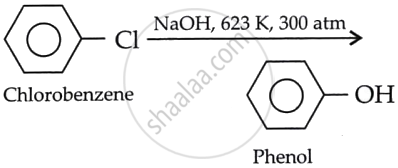
Chlorobenzene does not undergo hydrolysis under normal conditions. However, it undergoes hydrolysis when heated in an aqueous sodium hydroxide solution at 623 K and 300 atm, forming phenol. The presence of an electron-withdrawing group increases the reactivity of haloarenes.
APPEARS IN
RELATED QUESTIONS
Given reasons: C–Cl bond length in chlorobenzene is shorter than C–Cl bond length in CH3–Cl.
Write the structures of A, B and C in the following:

In the following pair of halogen compounds, which compound undergoes a faster SN1 reaction?

What are ambident nucleophiles? Explain with an example.
Write the structure of the major organic product in the following reaction:
\[\ce{CH3CH2Br + KCN ->[aq{.} ethanol]}\]
The stability order for carbocation is _______.
(A) 2° > 3° > 1°
(B) 3° > 2° > 1°
(C) 3° > 1° > 2°
(D) 1° > 3° > 2°
What is the action of the following on ethyl bromide?
silver acetate
AgCN reacts with haloalkanes to form isocyanide. Haloalkanes react with KCN to form alkyl cyanides as the main product. Why?
Which of the following is an example of SN2 reaction?
Isopropyl chloride undergoes hydrolysis by:
The correct order of increasing the reactivity of C–X bond towards nucleophile in following compounds.

(I)

(II)
(CH3)3CCl
(III)
(CH3)2CHCl
(IV)
Which reagent will you use for the following reaction?
\[\ce{CH3CH2CH2CH3 -> CH3CH2CH2CH2Cl + CH3CH2CHClCH3}\]

Which of the statements are correct about above reaction?
(i) (a) and (e) both are nucleophiles.
(ii) In (c) carbon atom is sp3 hybridised.
(iii) In (c) carbon atom is sp2 hybridised.
(iv) (a) and (e) both are electrophiles.
Chlorination of alkanes is an example of
When CH3CH2CHCl2 is treated NaNH2 product formed is:-
Racemisation occurs in ______.
Inversion of configuration occurs in ______.
Which one of the following chlorohydrocarbons readily undergoes solvolysis?
Which of the following reactions is an example of nucleophilic substitution reaction?
