Advertisements
Advertisements
Question
What happens when ethyl chloride is treated with aqueous KOH?
Advertisements
Solution 1
\[\ce{CH3 - CH2 - Cl ->[KOH/H2O]\underset{(S_N2 reaction)}{CH3 - CH2 - OH}}\]
Solution 2
When ethyl chloride is treated with aqueous KOH, it undergoes dehydrohalogenation, which eliminates hydrogen and halogen atoms from nearby carbon atoms, resulting in the production of an alcohol.
\[\ce{\underset{Ethyl chloride}{CH3 - CH2 - Cl} + KOH_{(aq)} ->[hydrolysis][\Delta] \underset{Ethyl alcohol}{CH3 - CH2 - OH} + KCl}\]
RELATED QUESTIONS
Discuss the mechanism of alkaline hydrolysis of bromomethane.
How do you convert the following:
Ethanol to propanenitrile
Out of  , which is more reactive towards SN1 reaction and why?
Write the mechanism of the following reaction:
\[\ce{{n}BuBr + KCN ->[EtOH-H2O] {n}BuCN}\]
What is the action of the following on ethyl bromide?
silver acetate
Which one is most reactive towards SN1 reaction?
The order of reactivity of the given haloalkanes towards nucleophile is:
The process of separation of a racemic modification into d and l-enantiomers is called ____________.
Which reagent will you use for the following reaction?
\[\ce{CH3CH2CH2CH3 -> CH3CH2CH2CH2Cl + CH3CH2CHClCH3}\]
Ethylene chloride and ethylidene chloride are isomers. Identify the correct statements.
(i) Both the compounds form same product on treatment with alcoholic KOH.
(ii) Both the compounds form same product on treatment with aq.NaOH.
(iii) Both the compounds form same product on reduction.
(iv) Both the compounds are optically active.
Write the structures and names of the compounds formed when compound ‘A’ with molecular formula, \[\ce{C7H8}\] is treated with \[\ce{Cl2}\] in the presence of \[\ce{FeCl3}\].
How do polar solvents help in the first step in SN1 mechanism?
In which reaction mechanism carbocation is formed?
The major product formed in the following reaction is:

Convert bromoethane to propanamine.
Give the mechanism of the following reaction:
\[\ce{CH3CH2OH ->[H2SO4][413 K] CH3CH2-O-CH2CH3 + H2O}\]
The following questions are case-based questions. Read the passage carefully and answer the questions that follow:
|
Nucleophilic Substitution: Influences of solvent polarity: The reaction rate (SN2) of 2-bromopropane and NaOH in ethanol containing 40% water is twice slower than in absolute ethanol. Hence the level of solvent polarity has an influence on both SN1 and SN2 reactions but with different results. Generally speaking, a weak polar solvent is favourable for SN2 reaction, while a strong polar solvent is favourable for SN1. Generally speaking, the substitution reaction of tertiary haloalkane is based on SN1 mechanism in solvents with a strong polarity (for example ethanol containing water). |
Answer the following questions:
(a) Why racemisation occurs in SN1? (1)
(b) Why is ethanol less polar than water? (1)
(c) Which one of, the following in each pair is more reactive towards SN2 reaction? (2)
(i) CH3 – CH2 – I or CH3CH2 – Cl
(ii)
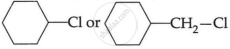
OR
(c) Arrange the following in the increasing order of their reactivity towards SN1 reactions: (2)
(i) 2-Bromo-2-methylbutane, 1-Bromo-pentane, 2-Bromo-pentane
(ii) 1-Bromo-3-methylbutane, 2-Bromo-2-methylbutane, 2-Bromo-3- methylbutane
Explain why Grignard reagents should be prepared under anhydrous conditions.
Consider the reactions,
(i) \[\begin{array}{cc}
\phantom{}\ce{\underset{}{(CH3)2CH - CH2Br} ->[C2H5OH] \underset{}{(CH3)2CH - CH2OC2H5 + HBr}}\\
\end{array}\]
(ii) \[\begin{array}{cc}
\phantom{}\ce{\underset{}{(CH3)2CH - CH2Br} ->[C2H5O-] \underset{}{(CH3)2CH - CH2OC2H5 + Br-}}\\
\end{array}\]
The mechanisms of reactions (i) and (ii) are respectively:
Which of the following reactions is an example of nucleophilic substitution reaction?
