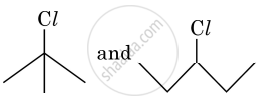
An SN1 reaction occurs through the formation of a carbocation intermediate. Alkyl halide (I) is tertiary (3°), whereas (II) is secondary (2°). As a result, (I) forms a tertiary carbocation, while (II) forms a secondary carbocation. Since the rate of an SN1 reaction increases with carbocation stability, and a tertiary carbocation is more stable than a secondary carbocation, compound (I), i.e., 2-chloro-2-methylpropane, undergoes the SN1 reaction faster than compound (II), i.e., 3-chloropentane.
Advertisements
Advertisements
Questions
In the following pair of halogen compounds, which compound undergoes a faster SN1 reaction?

In the following pair of halogen compounds, which compound undergoes SN1 reaction faster and why?
Short Answer
Advertisements
Solution 1
The activity of halogen compounds in SN1 reaction depends on the stability of the carbocation formed due to ionization. The order of stability is tertiary > secondary > primary. Hence, 3° alkyl chloride is more active than 2° alkyl chloride. Hence,3° alkyl chloride is more active in the SN1 reaction.
The compound which react faster is:

The carbocation, which will be more stable and responsible for the faster reaction, is:

shaalaa.com
Solution 2
shaalaa.com
Notes
Students should refer to the answer according to their questions.
Is there an error in this question or solution?
Chapter 6: Haloalkanes and Haloarenes - Intext Question [Page 186]
APPEARS IN
RELATED QUESTIONS
In the following pair of halogen compounds, which compound undergoes a faster SN1 reaction?

Which compound in the following pair will react faster in SN2 reaction with OH−?
(CH3)3CCl or CH3Cl
How will you bring about the following conversion?
Toluene to benzyl alcohol
SN1 reactions are accompanied by racemization in optically active alkyl halides.
In the reaction, \[\ce{R - X + NaOR' -> ROR’ + X}\] ( – ve ion). The main product formed is:
Which compound in the following pair reacts faster in SN2 reaction with OH–?
- CH3Br or CH3
- CH3Cl, (CH3)3CCl
Which of the following is an example of SN2 reaction?
The order of reactivity of the given haloalkanes towards nucleophile is:
Which among MeX, RCH2X, R2CHX and R3CX is most reactive towards SN2 reaction?
Which of the following is an optically active compound?
The process of separation of a racemic modification into d and l-enantiomers is called ____________.
The correct order of increasing the reactivity of C–X bond towards nucleophile in following compounds.

(I)

(II)
(CH3)3CCl
(III)
(CH3)2CHCl
(IV)
Match the reactions given in Column I with the types of reactions given in Column II.
| Column I | Column II | |
| (i) | 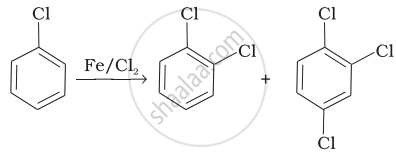 |
(a) Nucleophilic aromatic substitution |
| (ii) | \[\begin{array}{cc} \ce{CH3 - CH = CH2 + HBr -> CH3 - CH - CH3}\\ \phantom{............................}|\phantom{}\\ \phantom{.............................}\ce{Br}\phantom{} \end{array}\] |
(b) Electrophilic aromatic substitution |
| (iii) | 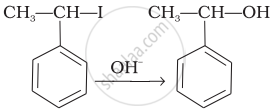 |
(c) Saytzeff elimination |
| (iv) | 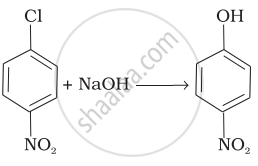 |
(d) Electrophilic addition |
| (v) | \[\begin{array}{cc} \ce{CH3 CH2 CH CH3 ->[alc.KOH] CH3 CH = CH CH3}\\ \phantom{}|\phantom{..........................}\\ \phantom{}\ce{Br}\phantom{........................} \end{array}\] |
(e) Nucleophilic substitution (SN1) |
Which one of the following compounds is more reactive towards SN1 reaction?
Which of the following compounds will show retention in configuration on nucleophile substitution by OH− ion?
In SN1 reactions, the correct order of reactivity for the following compounds:
CH3Cl, CH3CH2Cl, (CH3)2CHCl and (CH3)3CCl is ______.
Retention of configuration is observed in ______.
Explain why Grignard reagents should be prepared under anhydrous conditions.
Which alkyl halide from the following pair would you expect to react more rapidly by an SN2 mechanism? Explain your answer.
\[\begin{array}{cc}\ce{CH3CH2CHCH3}\\
\phantom{.....}|\\
\phantom{......}\ce{Br}\\
\end{array}\] or \[\begin{array}{cc}\phantom{.......}\ce{CH3}\\
\phantom{...}|\\
\ce{H3C - C - Br}\\
\phantom{...}|\\
\phantom{.......}\ce{CH3}\\
\end{array}\]
Which alkyl halide from the following pair would you expect to react more rapidly by an SN2 mechanism? Explain your answer.
\[\begin{array}{cc}
\ce{CH3CHCH2CH2Br}\\
|\phantom{.............}\\
\ce{CH3}\phantom{..........}\\
\end{array}\] or \[\begin{array}{cc}
\ce{CH3CH2CHCH2Br}\\
|\\
\phantom{...}\ce{CH3}\\
\end{array}\]
