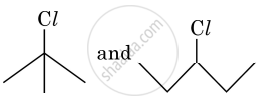
An SN1 reaction occurs through the formation of a carbocation intermediate. Alkyl halide (I) is tertiary (3°), whereas (II) is secondary (2°). As a result, (I) forms a tertiary carbocation, while (II) forms a secondary carbocation. Since the rate of an SN1 reaction increases with carbocation stability, and a tertiary carbocation is more stable than a secondary carbocation, compound (I), i.e., 2-chloro-2-methylpropane, undergoes the SN1 reaction faster than compound (II), i.e., 3-chloropentane.
Advertisements
Advertisements
प्रश्न
In the following pair of halogen compounds, which compound undergoes a faster SN1 reaction?

In the following pair of halogen compounds, which compound undergoes SN1 reaction faster and why?
लघु उत्तरीय
Advertisements
उत्तर १
The activity of halogen compounds in SN1 reaction depends on the stability of the carbocation formed due to ionization. The order of stability is tertiary > secondary > primary. Hence, 3° alkyl chloride is more active than 2° alkyl chloride. Hence,3° alkyl chloride is more active in the SN1 reaction.
The compound which react faster is:

The carbocation, which will be more stable and responsible for the faster reaction, is:

shaalaa.com
उत्तर २
shaalaa.com
Notes
Students should refer to the answer according to their questions.
क्या इस प्रश्न या उत्तर में कोई त्रुटि है?
अध्याय 6: Haloalkanes and Haloarenes - Intext Question [पृष्ठ १८६]
APPEARS IN
संबंधित प्रश्न
Which would undergo SN2 reaction faster in the following pair and why ?

Write the structures of A, B and C in the following:

The stability order for carbocation is _______.
(A) 2° > 3° > 1°
(B) 3° > 2° > 1°
(C) 3° > 1° > 2°
(D) 1° > 3° > 2°
In a coordination entity of the type [PtCl2(en)2]2+ which isomer will show optical isomerism?
In the reaction, \[\ce{R - X + NaOR' -> ROR’ + X}\] ( – ve ion). The main product formed is:
Which of the following pairs is/are correctly matched?
| Reaction | Product | |
| I | RX + AgCN | RNC |
| II | RX + KCN | RCN |
| III | RX + KNO2 | \[\begin{array}{cc} \phantom{.......}\ce{O}\\ \phantom{.....}/\\ \ce{R - N}\phantom{....}\\ \phantom{.....}\backslash\backslash\\ \phantom{.......}\ce{O} \end{array}\] |
| IV | RX + AgNO2 | \[\ce{R-O-N=O}\] |
Halogenation of alkanes is ____________.
Which of the following reactions is an example of nucleophilic substitution reaction?
Optically active isomers but not mirror images are called ____________.
SN2 mechanism proceeds through intervention of ____________.
An organic molecule necessarily shows optical activity if it ____________.
Which of the following is a chiral compound?
Identify the end product (C) in the following sequence:
\[\ce{C2H5OH ->[SOCl2][Pyridine] A ->[KCN {(alc.)}] B ->[2H2O/H^+] C}\]
Complete the following analogy:
Same molecular formula but different structures: A : : Non superimposable mirror images: B
Cyanide ion acts as an ambident nucleophile. From which end it acts as a stronger nucleophile in aqueous medium? Give reason for your answer.
Give reason for the following:
The product formed during SN1 reaction is a racemic mixture.
The number of chiral carbons present in the molecule given below is ______.

Assertion (A) : Nucleophilic substitution of iodoethane is easier than chloroethane.
Reason (R) : Bond enthalpy of C-I bond is less than that of C-Cl bond.
The following questions are case-based questions. Read the passage carefully and answer the questions that follow:
|
Nucleophilic Substitution: Influences of solvent polarity: The reaction rate (SN2) of 2-bromopropane and NaOH in ethanol containing 40% water is twice slower than in absolute ethanol. Hence the level of solvent polarity has an influence on both SN1 and SN2 reactions but with different results. Generally speaking, a weak polar solvent is favourable for SN2 reaction, while a strong polar solvent is favourable for SN1. Generally speaking, the substitution reaction of tertiary haloalkane is based on SN1 mechanism in solvents with a strong polarity (for example ethanol containing water). |
Answer the following questions:
(a) Why racemisation occurs in SN1? (1)
(b) Why is ethanol less polar than water? (1)
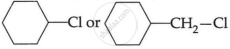
(c) Which one of, the following in each pair is more reactive towards SN2 reaction? (2)
(i) CH3 – CH2 – I or CH3CH2 – Cl
(ii)
OR
(c) Arrange the following in the increasing order of their reactivity towards SN1 reactions: (2)
(i) 2-Bromo-2-methylbutane, 1-Bromo-pentane, 2-Bromo-pentane
(ii) 1-Bromo-3-methylbutane, 2-Bromo-2-methylbutane, 2-Bromo-3- methylbutane
Which of the following is halogen exchange reaction?
