Advertisements
Advertisements
Questions
Arrange the compounds of the following set in order of reactivity towards SN2 displacement:
2-Bromo-2-methylbutane, 1-Bromopentane, 2-Bromopentane
Arrange the following compounds in increasing order of their reactivity towards SN2 displacement:
2-Bromo-2-methylbutane, 1-Bromopentane, 2–Bromopentane.
Advertisements
Solution
The SN2 reaction involves the formation of a transition state with the carbon atom surrounded by 5 additional atoms (groups). A transition state requires minimal steric interactions. The most suitable substrates for SN2 reactions are 1° alkyl halides, followed by 2° and 3° alkyl halides. The order of reactivity towards SN2 is 1° > 2° > 3° > aryl halide. Based on this, the order will be:
\[\begin{array}{cc}
\phantom{.................................}\ce{Br}\phantom{............................................}\ce{Br}\\
\phantom{................................}|\phantom{...............................................}|\\
\ce{\underset{1-Bromopentane}{H3C - (CH2)3 - CH2Br} > \ce{\underset{2-Bromopentane}{CH3 - CH - (CH2)2 - CH3}} > \ce{CH3 - C - CH2 - CH3}}\\
\phantom{................................................................................}|\\
\phantom{....................................................................................}\ce{\underset{2-Brmo-2-methylbutane}{CH3}}\\
\end{array}\]
APPEARS IN
RELATED QUESTIONS
Write the structure of an isomer of compound C4H9Br which is most reactive towards SN1 reaction
Which would undergo SN1 reaction faster in the following pair and why?

How will you bring about the following conversion?
Toluene to benzyl alcohol
SN1 reactions are accompanied by racemization in optically active alkyl halides.
The stability order for carbocation is _______.
(A) 2° > 3° > 1°
(B) 3° > 2° > 1°
(C) 3° > 1° > 2°
(D) 1° > 3° > 2°
Answer the following question.
Write one stereochemical difference between SN1 and SN2 reactions.
Which of the following is optically inactive?
Which of the following is an example of SN2 reaction?
Which of the following undergoes nucleophilic substitution exclusively by SN1 mechanism?
The increasing order of reactivity towards SN1 mechanism is:
(I) \[\begin{array}{cc}
\ce{CH3-CH-CH2-CH3}\\
|\phantom{........}\\
\ce{CH3}\phantom{.....}
\end{array}\]
(II) CH3CH2CH2Cl
(III) P–CH3O–C6H4–CH2Cl
Which of the following alkyl halides will undergo SN1 reaction most readily?
Ethylene chloride and ethylidene chloride are isomers. Identify the correct statements.
(i) Both the compounds form same product on treatment with alcoholic KOH.
(ii) Both the compounds form same product on treatment with aq.NaOH.
(iii) Both the compounds form same product on reduction.
(iv) Both the compounds are optically active.
Aryl halides are extremely less reactive towards nucleophilic substitution. Predict and explain the order of reactivity of the following compounds towards nucleophilic substitution:
| (I) |  |
| (II) |  |
| (III) |  |
Cyanide ion acts as an ambident nucleophile. From which end it acts as a stronger nucleophile in aqueous medium? Give reason for your answer.
Give reason for the following:
The product formed during SN1 reaction is a racemic mixture.
The decreasing order of reactivity of the following compounds towards nucleophilic substitution (SN2) is ______.

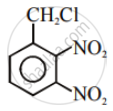

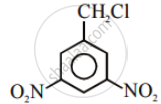
Assertion (A) : Nucleophilic substitution of iodoethane is easier than chloroethane.
Reason (R) : Bond enthalpy of C-I bond is less than that of C-Cl bond.
Retention of configuration is observed in ______.
The correct order of increasing reactivity of
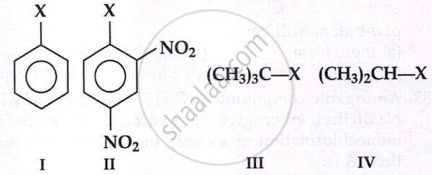
C-X bond towards nucleophile in the following compounds is:
Assertion (A):  undergoes SN2 reactions faster than
  .
.
Reason (R): Iodine is a better leaving group because of its large size.
In the light of the above statements, choose the correct answer from the options given below:
