Advertisements
Advertisements
Question
Write the mechanism of the following reaction:
\[\ce{{n}BuBr + KCN ->[EtOH-H2O] {n}BuCN}\]
Advertisements
Solution 1
This reaction is a first-order nucleophilic substitution (SN1). The mechanism can be stated as:
Step 1: Generation of nucleophile:
\[\ce{KCN ->[EtOH-H2O]K+ + \overset{-}{C} ≡ N}\]
Step 2: Nucleophilic attack and formation of the transition state:
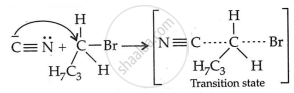
Step 3: Generation of product:
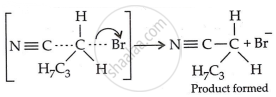
Therefore, we have
\[\ce{CH3 - CH2 - CH2 - CH2 - Br + KCN ->[EtOH/H2O]CH3CH2CH2CH2CN + KBr}\]
Solution 2
KCN is the resonating hybrid of the following structures:
\[\ce{K^+ [^- ^{\bullet}_{\bullet}C ≡ N^{\bullet}_{\bullet} <-> ^{\bullet}_{\bullet}C = \overset{\bullet\bullet}{N}^{\bullet}_{\bullet}^-]}\]
Therefore, CN− acts as an ambident nucleophile. It can attack the carbon atom of the C–Br bond in n-BuBr through either the carbon (C) or nitrogen (N) atom. Since the C–N bond is weaker than the C–C bond, the attack occurs at the carbon atom, leading to the formation of n-butyl cyanide.
\[\ce{K^+CN^- + \underset{n-butyl bromide}{CH3CH2CH2\overset{\delta+}{C}H2 - \overset{\delta-}{B}r} -> \underset{n-butyl cyanide}{CH3CH2CH2CH2CN} + KBr}\]
APPEARS IN
RELATED QUESTIONS
Write the major products(s) in the following:

How do you convert the following:
Ethanol to propanenitrile
Which would undergo SN2 reaction faster in the following pair and why ?
CH3 – CH2 – Br and CH3 – CH2 – I
Answer the following question.
Write one stereochemical difference between SN1 and SN2 reactions.
Which compound in the following pair reacts faster in SN2 reaction with OH–?
- CH3Br or CH3
- CH3Cl, (CH3)3CCl
Which of the following is optically inactive?
Which one of the following halogen compounds is difficult to be hydrolysed by SN1 mechanism?
Optically active isomers but not mirror images are called ____________.
Which of the following is an optically active compound?
An important chemical method to resolve a racemic mixture makes use of the formation of ______.
The process of separation of a racemic modification into d and l-enantiomers is called ____________.
Which of the following compounds is optically active?
SN1 reaction of alkyl halides lead to ___________.
The increasing order of reactivity towards SN1 mechanism is:
(I) \[\begin{array}{cc}
\ce{CH3-CH-CH2-CH3}\\
|\phantom{........}\\
\ce{CH3}\phantom{.....}
\end{array}\]
(II) CH3CH2CH2Cl
(III) P–CH3O–C6H4–CH2Cl
Elimination reactions (especially β-elimination) are as common as the nucleophilic substitution reaction in case of alkyl halides. Specify the reagents used in both cases.
Which one of the following compounds is more reactive towards SN1 reaction?
Racemisation occurs in ______.
Give the mechanism of the following reaction:
\[\ce{CH3CH2OH ->[H2SO4][413 K] CH3CH2-O-CH2CH3 + H2O}\]
Which of the following reactions is an example of nucleophilic substitution reaction?
The compound that will undergo SN1 reaction with the fastest rate is:
