Advertisements
Advertisements
प्रश्न
Write the mechanism of the following reaction:
\[\ce{{n}BuBr + KCN ->[EtOH-H2O] {n}BuCN}\]
Advertisements
उत्तर १
This reaction is a first-order nucleophilic substitution (SN1). The mechanism can be stated as:
Step 1: Generation of nucleophile:
\[\ce{KCN ->[EtOH-H2O]K+ + \overset{-}{C} ≡ N}\]
Step 2: Nucleophilic attack and formation of the transition state:
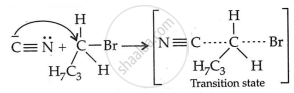
Step 3: Generation of product:
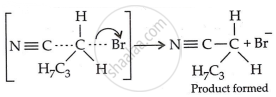
Therefore, we have
\[\ce{CH3 - CH2 - CH2 - CH2 - Br + KCN ->[EtOH/H2O]CH3CH2CH2CH2CN + KBr}\]
उत्तर २
KCN is the resonating hybrid of the following structures:
\[\ce{K^+ [^- ^{\bullet}_{\bullet}C ≡ N^{\bullet}_{\bullet} <-> ^{\bullet}_{\bullet}C = \overset{\bullet\bullet}{N}^{\bullet}_{\bullet}^-]}\]
Therefore, CN− acts as an ambident nucleophile. It can attack the carbon atom of the C–Br bond in n-BuBr through either the carbon (C) or nitrogen (N) atom. Since the C–N bond is weaker than the C–C bond, the attack occurs at the carbon atom, leading to the formation of n-butyl cyanide.
\[\ce{K^+CN^- + \underset{n-butyl bromide}{CH3CH2CH2\overset{\delta+}{C}H2 - \overset{\delta-}{B}r} -> \underset{n-butyl cyanide}{CH3CH2CH2CH2CN} + KBr}\]
APPEARS IN
संबंधित प्रश्न
Write the structure of an isomer of compound C4H9Br which is most reactive towards SN1 reaction
Write the structure of the major product in each of the following reaction :

In the following pair of halogen compounds, which compound undergoes a faster SN1 reaction?

Which compound in the following pair will react faster in SN2 reaction with OH−?
CH3Br or CH3I
Which of the following pairs is/are correctly matched?
| Reaction | Product | |
| I | RX + AgCN | RNC |
| II | RX + KCN | RCN |
| III | RX + KNO2 | \[\begin{array}{cc} \phantom{.......}\ce{O}\\ \phantom{.....}/\\ \ce{R - N}\phantom{....}\\ \phantom{.....}\backslash\backslash\\ \phantom{.......}\ce{O} \end{array}\] |
| IV | RX + AgNO2 | \[\ce{R-O-N=O}\] |
Which one of the following halogen compounds is difficult to be hydrolysed by SN1 mechanism?
In the SN1 reaction, racemization takes place. It is due to:
Identify X and Y in the following sequence:
\[\ce{C2H5Br ->[X] Product ->[Y] C3H7NH2}\]
Which of the following compound will undergo racemisation when reacts with aq. KOH?
(i)

(ii)
CH3CH2CH2Cl
(iii)
\[\begin{array}{cc}
\ce{CH3}\phantom{..}\\
|\phantom{....}\\
\ce{CH3-CH-CH2Cl}
\end{array}\]
(iv)
\[\begin{array}{cc}
\phantom{..}\ce{H}\\
\phantom{..}|\\
\ce{CH3-C-Cl}\\
\phantom{..}|\\
\phantom{.....}\ce{C2H5}
\end{array}\]
The increasing order of reactivity towards SN1 mechanism is:
(I) \[\begin{array}{cc}
\ce{CH3-CH-CH2-CH3}\\
|\phantom{........}\\
\ce{CH3}\phantom{.....}
\end{array}\]
(II) CH3CH2CH2Cl
(III) P–CH3O–C6H4–CH2Cl
Which reagent will you use for the following reaction?
\[\ce{CH3CH2CH2CH3 -> CH3CH2CH2CH2Cl + CH3CH2CHClCH3}\]

Which of the statements are correct about above reaction?
(i) (a) and (e) both are nucleophiles.
(ii) In (c) carbon atom is sp3 hybridised.
(iii) In (c) carbon atom is sp2 hybridised.
(iv) (a) and (e) both are electrophiles.
Which of the compounds will react faster in SN1 reaction with the –OH ion?
\[\ce{CH3-CH2-Cl}\] or \[\ce{C6H5-CH2-Cl}\]
Cyanide ion acts as an ambident nucleophile. From which end it acts as a stronger nucleophile in aqueous medium? Give reason for your answer.
Which of the following is the definition of chirality?
Retention of configuration is observed in ______.
Inversion of configuration occurs in ______.
Which alkyl halide from the following pair would you expect to react more rapidly by an SN2 mechanism? Explain your answer.
\[\begin{array}{cc}\ce{CH3CH2CHCH3}\\
\phantom{.....}|\\
\phantom{......}\ce{Br}\\
\end{array}\] or \[\begin{array}{cc}\phantom{.......}\ce{CH3}\\
\phantom{...}|\\
\ce{H3C - C - Br}\\
\phantom{...}|\\
\phantom{.......}\ce{CH3}\\
\end{array}\]
Consider the reactions,
(i) \[\begin{array}{cc}
\phantom{}\ce{\underset{}{(CH3)2CH - CH2Br} ->[C2H5OH] \underset{}{(CH3)2CH - CH2OC2H5 + HBr}}\\
\end{array}\]
(ii) \[\begin{array}{cc}
\phantom{}\ce{\underset{}{(CH3)2CH - CH2Br} ->[C2H5O-] \underset{}{(CH3)2CH - CH2OC2H5 + Br-}}\\
\end{array}\]
The mechanisms of reactions (i) and (ii) are respectively:
Which of the following reactions is an example of nucleophilic substitution reaction?
