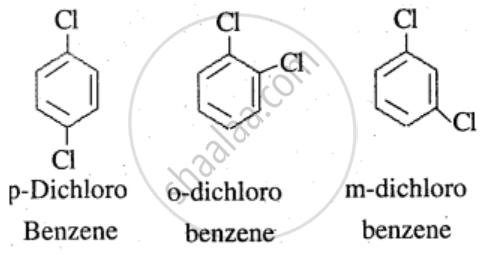
The melting point of p-dichlorobenzene is higher than that of its ortho- and meta-isomers due to its highly symmetrical structure. This symmetry allows the molecules to pack more efficiently and tightly in the crystal lattice, forming a more stable and orderly solid. As a result, stronger intermolecular forces hold the molecules together, and more energy (heat) is required to break these interactions during melting. In contrast, the less symmetrical o- and m-isomers pack less efficiently, have weaker intermolecular forces, and thus melt at lower temperatures.
Advertisements
Advertisements
Questions
p-Dichlorobenzene has higher m.p. and lower solubility than those of o- and m-isomers. Discuss.
Why p-dichlorobenzene has higher melting point than those of ortho and meta-isomers?
p-Dichlorobenzene has higher m.p. than those of o- and m-isomers. Discuss.
Why is the melting point of p-dichlorobenzene higher than that of o- and m-isomers?
Short Answer
Advertisements
Solution
shaalaa.com
Is there an error in this question or solution?
Chapter 6: Haloalkanes and Haloarenes - Exercises [Page 190]
APPEARS IN
RELATED QUESTIONS
Define racemic mixture.
For the same alkyl group, an alkyl bromide has a higher boiling point than alkyl fluoride because:
Which of the following compounds has the highest boiling point?
Which of the following halide is 2°?
The decreasing order of boiling points of alkyl halides is:
Which of the following is liquid at room temperature (b.p. is shown against it)?
Arrange the following compounds in increasing order of their boiling points.
(a) \[\begin{array}{cc}
\ce{CH3}\phantom{..................}\\
\backslash\phantom{...........}\\
\ce{CH - CH - CH2Br}\\
/\phantom{.............}\\
\ce{CH3}\phantom{..................}
\end{array}\]
(b) \[\ce{CH3CH2CH2CH2Br}\]
(c) \[\begin{array}{cc}
\phantom{...}\ce{CH3}\\
\phantom{}|\\
\ce{H3C - C - CH3}\\
\phantom{}|\\
\phantom{..}\ce{Br}
\end{array}\]
Which is the correct increasing order of boiling points of the following compounds?
1-Iodobutane, 1-Bromobutane, 1-Chlorobutane, Butane
Which is the correct increasing order of boiling points of the following compounds?
1-Bromoethane, 1-Bromopropane, 1-Bromobutane, Bromobenzene
Which of the following compounds will have the highest melting point and why?
| (I) |  |
|
(II) |
 |
| (III) | 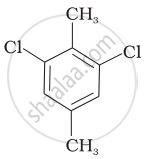 |
Arrange the following compounds in increasing order of their boiling points:
CH3CH2OH, CH3−CHO, CH3−COOH
Write the structure of the following organic halogen compound.
1,4-Dibromobut-2-ene
Write the structure of the following organic halogen compound.
4-tert-Butyl-3-iodoheptane
Write the structure of the following organic halogen compound.
4-tert-Butyl-3-iodoheptane
Name the following halides according to the IUPAC system and classify them as alkyl, allyl, benzyl (primary, secondary, tertiary), vinyl or aryl halide:
\[\ce{CH3 C(C2H5)2CH2Br}\]
Write the structure of the following organic halogen compound.
4-tert-Butyl-3-iodoheptane
