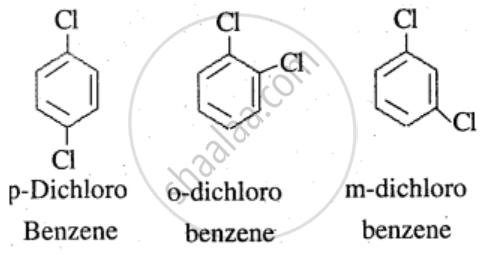
The melting point of p-dichlorobenzene is higher than that of its ortho- and meta-isomers due to its highly symmetrical structure. This symmetry allows the molecules to pack more efficiently and tightly in the crystal lattice, forming a more stable and orderly solid. As a result, stronger intermolecular forces hold the molecules together, and more energy (heat) is required to break these interactions during melting. In contrast, the less symmetrical o- and m-isomers pack less efficiently, have weaker intermolecular forces, and thus melt at lower temperatures.
Advertisements
Advertisements
प्रश्न
p-Dichlorobenzene has higher m.p. and lower solubility than those of o- and m-isomers. Discuss.
Why p-dichlorobenzene has higher melting point than those of ortho and meta-isomers?
p-Dichlorobenzene has higher m.p. than those of o- and m-isomers. Discuss.
Why is the melting point of p-dichlorobenzene higher than that of o- and m-isomers?
लघु उत्तरीय
Advertisements
उत्तर
shaalaa.com
क्या इस प्रश्न या उत्तर में कोई त्रुटि है?
अध्याय 6: Haloalkanes and Haloarenes - Exercises [पृष्ठ १९०]
APPEARS IN
संबंधित प्रश्न
Arrange the set of compounds in order of increasing boiling points.
1-Chloropropane, Isopropyl chloride, 1-Chlorobutane.
Explain why alkyl halides, though polar, are immiscible with water?
Define racemic mixture.
Which of the following possesses the highest melting point?
Arrange the following compounds in increasing order of their boiling points.
(a) \[\begin{array}{cc}
\ce{CH3}\phantom{..................}\\
\backslash\phantom{...........}\\
\ce{CH - CH - CH2Br}\\
/\phantom{.............}\\
\ce{CH3}\phantom{..................}
\end{array}\]
(b) \[\ce{CH3CH2CH2CH2Br}\]
(c) \[\begin{array}{cc}
\phantom{...}\ce{CH3}\\
\phantom{}|\\
\ce{H3C - C - CH3}\\
\phantom{}|\\
\phantom{..}\ce{Br}
\end{array}\]
Which is the correct increasing order of boiling points of the following compounds?
1-Bromoethane, 1-Bromopropane, 1-Bromobutane, Bromobenzene
Out of o-and p-dibromobenzene which one has higher melting point and why?
Which of the following compounds will have the highest melting point and why?
| (I) |  |
|
(II) |
 |
| (III) | 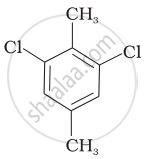 |
Which out of the following is an intensive property?
Why is the boiling point of o-dichlorobenzene higher than p-dichlorobenzene, but the melting point of para-isomer is higher than ortho-isomer?
Arrange the isomeric dichlorobenzene in the increasing order of their boiling point and melting points.
Write the structure of the following organic halogen compound.
1,4-Dibromobut-2-ene
Write the structure of the following organic halogen compound.
4-tert-Butyl-3-iodoheptane
Write the structure of the following organic halogen compound:
4-tert-Butyl-3-iodoheptane
Write the structure of the following organic halogen compound.
4-tert-Butyl-3-iodoheptane
