Advertisements
Advertisements
Question
Arrange the following compounds in the increasing order of their densities.
(a)

(b)

(c)
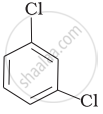
(d)

Options
(a) < (b) < (c) < (d)
(a) < (c) < (d) < (b)
(d) < (c) < (b) < (a)
(b) < (d) < (c) < (a)
Advertisements
Solution
(a) < (b) < (c) < (d)
Explanation:
The density increases with increase in number of carbon atoms, halogen atoms and atomic masses of the halogen atoms bounded with the alkyl or aryl groups. Or, in other words density is related to molecular mass of the compound. Higher the molecular mass, greater will be the density of the compound.
APPEARS IN
RELATED QUESTIONS
Arrange the set of compounds in order of increasing boiling points.
Bromomethane, Bromoform, Chloromethane, Dibromomethane.
Arrange the set of compounds in order of increasing boiling points.
1-Chloropropane, Isopropyl chloride, 1-Chlorobutane.
Explain why alkyl halides, though polar, are immiscible with water?
p-Dichlorobenzene has higher m.p. and lower solubility than those of o- and m-isomers. Discuss.
Define racemic mixture.
For the same alkyl group, an alkyl bromide has a higher boiling point than alkyl fluoride because:
Which of the following compounds has the highest boiling point?
How many structural isomers are possible for a compound with the molecular formula C3H7Cl?
Which of the following halide is 2°?
Which of the following is liquid at room temperature (b.p. is shown against it)?
Which of the following possesses the highest melting point?
p-dichlorobenzene has a higher melting point than its o- and m-isomers because ____________.
Reaction of \[\ce{C6H5CH2Br}\] with aqueous sodium hydroxide follows ______.
Why alkyl halides though polar are immiscible with water?
Why is the boiling point of o-dichlorobenzene higher than p-dichlorobenzene, but the melting point of para-isomer is higher than ortho-isomer?
Write the structure of the following organic halogen compound.
1,4-Dibromobut-2-ene
Write the structure of the following organic halogen compound.
4-tert-Butyl-3-iodoheptane
