Advertisements
Advertisements
Question
Reaction of \[\ce{C6H5CH2Br}\] with aqueous sodium hydroxide follows ______.
Options
SN1 mechanism
SN2 mechanism
Any of the above two depending upon the temperature of reaction
Saytzeff rule
Advertisements
Solution
Reaction of \[\ce{C6H5CH2Br}\] with aqueous sodium hydroxide follows SN1 mechanism.
Explanation:
Greater the stability of carbonation, greater will be its ease of formation from alkyl halide and faster will be the rate of reaction. In case of alkyl halides, 3° carbocations.
For the same reasons, allylic and benzylic halides show high reactivity towards the SN1 reaction. The carbonation thus formed gets stabilized through resonance as shown below:
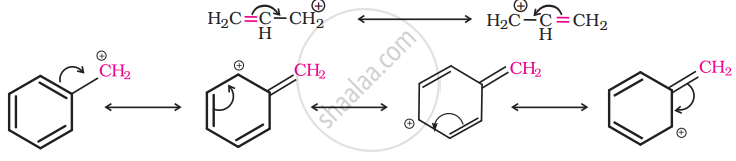
So, as the given compound, \[\ce{C6HCH2Cl}\] is a benzylic halide, it would undergo SN1 reaction.
APPEARS IN
RELATED QUESTIONS
Explain why alkyl halides, though polar, are immiscible with water?
Why dextro and laevorotatory isomers of Butan-2-ol are difficult to separate by fractional distillation?
For the same alkyl group, an alkyl bromide has a higher boiling point than alkyl fluoride because:
Which of the following compounds has the highest boiling point?
Mg reacts with RBr best in ____________.
Which is the correct increasing order of boiling points of the following compounds?
1-Iodobutane, 1-Bromobutane, 1-Chlorobutane, Butane
Which is the correct increasing order of boiling points of the following compounds?
1-Bromoethane, 1-Bromopropane, 1-Bromobutane, Bromobenzene
Assertion: The boiling points of alkyl halides decrease in the order:
RI > RBr > RCl > RF
Reason: The boiling points of alkyl chlorides, bromides and iodides are considerably higher than that of the hydrocarbon of comparable molecular mass.
Which out of the following is an intensive property?
Arrange the following compounds in increasing order of their boiling points:
CH3CH2OH, CH3−CHO, CH3−COOH
Why is the boiling point of o-dichlorobenzene higher than p-dichlorobenzene, but the melting point of para-isomer is higher than ortho-isomer?
Write the structure of the following organic halogen compound.
4-tert-Butyl-3-iodoheptane
Write the structure of the following organic halogen compound.
4-tert-Butyl-3-iodoheptane
Write the structure of the following organic halogen compound.
4-tert-Butyl-3-iodoheptane
Write the structure of the following organic halogen compound:
4-tert-Butyl-3-iodoheptane
Name the following halides according to the IUPAC system and classify them as alkyl, allyl, benzyl (primary, secondary, tertiary), vinyl or aryl halide:
\[\ce{CH3 C(C2H5)2CH2Br}\]
Write the structure of the following organic halogen compound.
4-tert-Butyl-3-iodoheptane
