Advertisements
Advertisements
Question
Which reagent will you use for the following reaction?
\[\ce{CH3CH2CH2CH3 -> CH3CH2CH2CH2Cl + CH3CH2CHClCH3}\]
Options
Cl2/UV light
\[\ce{NaCl + H2CO4}\]
Cl2 gas in dark
Cl2 gas in the presence of iron in dark
Advertisements
Solution
Cl2/UV light
Explanation:
Free radical chlorination or bromination of alkanes gives a complex mixture of isomeric mono- and polyhaloalkanes, which is difficult to separate as pure compounds. In this case, a mixture of the two isomeric forms of butane is obtained by the use of Cl2/UV light as per the reaction below -
\[\ce{CH3CH2CH2CH3 ->[Cl2/UV light][or heat] CH3CH2CH2CH2Cl + CH3CH2CHClCH3}\]
APPEARS IN
RELATED QUESTIONS
Which would undergo SN2 reaction faster in the following pair and why ?

Write the isomers of the compound having the formula C4H9Br.
Write the structure of the major organic product in the following reaction:
\[\ce{CH3CH(Br)CH2CH3 + NaOH ->[water]}\]
The order of reactivity of the given haloalkanes towards nucleophile is:
In the SN1 reaction, racemization takes place. It is due to:
SN2 mechanism proceeds through intervention of ____________.
An organic molecule necessarily shows optical activity if it ____________.
Among the following, the dissociation constant is highest for:
Identify the end product (C) in the following sequence:
\[\ce{C2H5OH ->[SOCl2][Pyridine] A ->[KCN {(alc.)}] B ->[2H2O/H^+] C}\]
Identify X and Y in the following sequence:
\[\ce{C2H5Br ->[X] Product ->[Y] C3H7NH2}\]
Which of the following alkyl halides will undergo SN1 reaction most readily?
Ethylene chloride and ethylidene chloride are isomers. Identify the correct statements.
(i) Both the compounds form same product on treatment with alcoholic KOH.
(ii) Both the compounds form same product on treatment with aq.NaOH.
(iii) Both the compounds form same product on reduction.
(iv) Both the compounds are optically active.
Compound ‘A’ with molecular formula \[\ce{C4H9Br}\] is treated with aq. \[\ce{KOH}\] solution. The rate of this reaction depends upon the concentration of the compound ‘A’ only. When another optically active isomer ‘B’ of this compound was treated with aq. \[\ce{KOH}\] solution, the rate of reaction was found to be dependent on concentration of compound and \[\ce{KOH}\] both.
(i) Write down the structural formula of both compounds ‘A’ and ‘B’.
(ii) Out of these two compounds, which one will be converted to the product with inverted configuration.
How do polar solvents help in the first step in SN1 mechanism?
Give reason for the following:
The product formed during SN1 reaction is a racemic mixture.
The number of chiral carbons present in the molecule given below is ______.

The decreasing order of reactivity of the following compounds towards nucleophilic substitution (SN2) is ______.

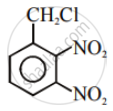

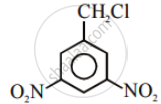
Discuss SN2 mechanism of methyl bromide using aqueous KOH.
The correct order of increasing reactivity of
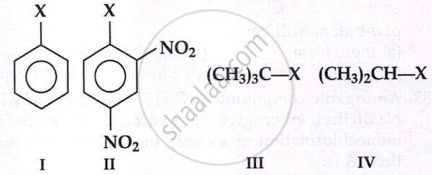
C-X bond towards nucleophile in the following compounds is:
