Advertisements
Advertisements
प्रश्न
Arrange the following compounds in the increasing order of their densities.
(a)

(b)

(c)
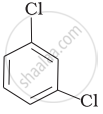
(d)

पर्याय
(a) < (b) < (c) < (d)
(a) < (c) < (d) < (b)
(d) < (c) < (b) < (a)
(b) < (d) < (c) < (a)
Advertisements
उत्तर
(a) < (b) < (c) < (d)
Explanation:
The density increases with increase in number of carbon atoms, halogen atoms and atomic masses of the halogen atoms bounded with the alkyl or aryl groups. Or, in other words density is related to molecular mass of the compound. Higher the molecular mass, greater will be the density of the compound.
APPEARS IN
संबंधित प्रश्न
Give reasons : n-Butyl bromide has higher boiling point than t-butyl bromide.
Arrange the set of compounds in order of increasing boiling points.
1-Chloropropane, Isopropyl chloride, 1-Chlorobutane.
p-Dichlorobenzene has higher m.p. and lower solubility than those of o- and m-isomers. Discuss.
The decreasing order of boiling points of alkyl halides is:
Which of the following is liquid at room temperature (b.p. is shown against it)?
p-dichlorobenzene has a higher melting point than its o- and m-isomers because ____________.
Arrange the following compounds in increasing order of their boiling points.
(a) \[\begin{array}{cc}
\ce{CH3}\phantom{..................}\\
\backslash\phantom{...........}\\
\ce{CH - CH - CH2Br}\\
/\phantom{.............}\\
\ce{CH3}\phantom{..................}
\end{array}\]
(b) \[\ce{CH3CH2CH2CH2Br}\]
(c) \[\begin{array}{cc}
\phantom{...}\ce{CH3}\\
\phantom{}|\\
\ce{H3C - C - CH3}\\
\phantom{}|\\
\phantom{..}\ce{Br}
\end{array}\]
Out of o-and p-dibromobenzene which one has higher melting point and why?
Which out of the following is an intensive property?
Why alkyl halides though polar are immiscible with water?
Arrange the isomeric dichlorobenzene in the increasing order of their boiling point and melting points.
Write the structure of the following organic halogen compound.
1,4-Dibromobut-2-ene
Write the structure of the following organic halogen compound.
4-tert-Butyl-3-iodoheptane
Write the structure of the following organic halogen compound.
4-tert-Butyl-3-iodoheptane
Name the following halides according to the IUPAC system and classify them as alkyl, allyl, benzyl (primary, secondary, tertiary), vinyl or aryl halide:
\[\ce{CH3 C(C2H5)2CH2Br}\]
Write the structure of the following organic halogen compound.
4-tert-Butyl-3-iodoheptane
