Advertisements
Advertisements
Question
What happens to a ferromagnetic material when its temperature increases above curie temperature?
Advertisements
Solution
A ferromagnetic material is made up of small regions known as domains. The atomic magnetic moments of nearest-neighbour atoms interact strongly within each domain via exchange interaction, a quantum mechanical phenomenon, and align parallel to each other even in the absence of an external magnetic field. As a result, a domain is spontaneously magnetised to saturation.
Only up to a specific temperature does the material keep its domain structure. When heated, the increased thermal agitation opposes spontaneous domain magnetization. Finally, at a critical temperature known as the Curie point or Curie temperature, thermal agitation overcomes the exchange forces and maintains the atomic magnetic moments randomly oriented. As a result, the material becomes paramagnetic above the Curie point. The ferromagnetic to paramagnetic transition is a transition from order to disorder. The material becomes ferromagnetic again when cooled below the Curie point.
RELATED QUESTIONS
Distinguish between ‘paramagnetic’ and ‘ferromagnetic’ substances.
Give any ‘two’ points of differences between diamagnetic and ferromagnetic substances.
The susceptibility of magnesium at 200 K is 1.8 x 10⁻⁵. At what temperature will the susceptibility decrease by 6 x 10⁻⁶?
In what way is the behaviour of a diamagnetic material different from that of a paramagnetic, when kept in an external magnetic field?
Distinguish between diamagnetic and paramagnetic substances.
A meter gauge train is heading north with speed 54 km/hr in earth's magnetic field 3 x 10⁻⁴T. The e.m.f. induced across the axle joining the wheels is ..........
(a) 0.45 mV
(b) 4.5 mV
(c) 45 mV
(d) 450 m V
The magnetic susceptibility of annealed iron at saturation is 4224. Find the permeability of
annealed iron at saturation. (μ0 = 4Π × 10−7 SI unit)
The susceptibility of a magnetic material is 0·9853. Identify the type of magnetic material. Draw the modification of the field pattern on keeping a piece of this material in a uniform magnetic field.
Which of the following substances are diamagnetic?
Bi, Al, Na, Cu, Ca and Ni
Which of the following substances are para-magnetic?
Bi, Al, Cu, Ca, Pb, Ni
The susceptibility of a magnetic material is − 2.6 × 10⁻⁵. Identify the type of magnetic material and state its two properties.
Draw magnetic field line when a (i) diamagnetic, (ii) paramagnetic substance is placed in an external magnetic field. Which magnetic property distinguishes this behaviour of the field line due to the substances?
The magnetic susceptibility of platinum is 0.0001. It's relative permeability is:
Choose the correct option:
A magnetising field of 360 Am−1 produces a magnetic flux density (B) = 0.6T in a ferromagnetic material. What is its permeability in Tm A−1?
A paramagnetic gas has 2.0 × 1026 atoms/m with atomic magnetic dipole moment of 1.5 × 10⁻²³ A m2 each. The gas is at 27°C.
- Find the maximum magnetization intensity of this sample.
- If the gas in this problem is kept in a uniform magnetic field of 3 T, is it possible to achieve saturation magnetization? Why?
The susceptibility of a paramagnetic material is χ at 27° C. At what temperature its susceptibility be χ/3?
A rod of magnetic material of cross-section 0.25 cm2 is placed in a magnetizing field of intensity 4000 A/m-1. The magnetic flux passing through the rod is 25 × 10-6 Wb. Find out
(a) relative permeability
(b) magnetic susceptibility and
(c) magnetisation of the rod.
Two identical bar magnets each of magnetic moment M, separated by some distance are kept perpendicular to each other. The magnetic induction at a point at the same distance d from the centre of magnets, is (µ0 = permeability of free space)
For a paramagnetic substance, the magnetic susceptibility is ______.
The magnetic susceptibility of a paramagnetic material at - 73 °C is 0.0075. Its value at -173 °C will be ______.
Magnetization of the sample is ______.
If a magnetic field is applied to a liquid in one arm of a narrow U-tube, the liquid level in that arm is lowered. The liquid in U-tube arm is ______.
The product of magnetic susceptibility (`chi`) and absolute temperature (T) is constant for a ____________.
A sphere of gold when brought towards a powerful magnet experiences ____________.
A domain in a ferromagnetic substance is in the form of a cube of side length 1 µm. If it contains 6 x 10¹⁰ atoms and each atomic dipole has a dipole moment of 7 x 10-24 Am2, then magnetization of the domain is ____________.
The earth’s field departs from its dipole shape substantially at large distances (greater than about 30,000 km). What agencies may be responsible for this distortion?
Which graph shows the variation of magnetic susceptibility (`chi`) with magnetizing field (H) for a paramagnetic substance?
Why does a paramagnetic sample display greater magnetisation (for the same magnetising field) when cooled?
Would the maximum possible magnetisation of a paramagnetic sample be of the same order of magnitude as the magnetisation of a ferromagnet?
A certain region of space is to be shielded from magnetic fields. Suggest a method.
A Rowland ring of mean radius 15 cm has 3500 turns of wire wound on a ferromagnetic core of relative permeability 800. What is the magnetic field B in the core for a magnetising current of 1.2 A?
Nickel shows ferromagnetic property at room temperature. If the temperature is increased beyond curie temperature, then it will show ______.
Assertion: The ferromagnetic substance do not obey Curie’s law.
Reason: At Curie point a ferromagnetic substance start behaving as a paramagnetic substance.
The coercivity of a small magnet where the ferromagnet gets demagnetized is 3 × 10³ Am–1. The current required to be passed in a solenoid of length 10 cm and number of turns 100, so that the magnet gets demagnetized when inside the solenoid, is ______.
Assertion: A paramagnetic sample display greater magnetisation (for the same magnetic field) when cooled.
Reason: The magnetisation does not depend on temperature.
Which of the following property shows the property of ferromagnetic substances?
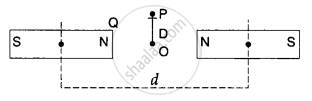
Two identical bar magnets are fixed with their centres at a distance d apart. A stationary charge Q is placed at P in between the gap of the two magnets at a distance D from the centre O as shown in the figure. The force on the charge Q is ______.
The universal property of all substances is ______.
A paramagnetic sample shows a net magnetisation of 8 Am–1 when placed in an external magnetic field of 0.6 T at a temperature of 4 K. When the same sample is placed in an external magnetic field of 0.2 T at a temperature of 16 K, the magnetisation will be ______.
S is the surface of a lump of magnetic material.
- Lines of B are necessarily continuous across S.
- Some lines of B must be discontinuous across S.
- Lines of H are necessarily continuous across S.
- Lines of H cannot all be continuous across S.
A permanent magnet in the shape of a thin cylinder of length 10 cm has M = 106 A/m. Calculate the magnetisation current IM.
Explain quantitatively the order of magnitude difference between the diamagnetic susceptibility of N2 (~5 × 10⁻⁹) (at STP) and Cu (~10–5).
From molecular view point, discuss the temperature dependence of susceptibility for diamagnetism, paramagnetism and ferromagnetism.
Magnetic susceptibility for a paramagnetic and diamagnetic materials is respectively ______.
Which of the following has a permeability less than that of free space?
Which of the following cannot modify an external magnetic field as shown in the figure?

Explain ferromagnetism on the basis of the domain theory.
Explain the origin of paramagnetism on the basis of atomic structure.
Magnetic susceptibility of a diamagnetic substance ______.
