Advertisements
Advertisements
Question
What is a spectrum?
Advertisements
Solution
The band of colored components of a beam of light is called a spectrum.
APPEARS IN
RELATED QUESTIONS
Choose the correct alternative and rewrite the following sentence.
A ray of light strikes the glass slab at an angle of 50°. What is the angle of incidence?
A student traces the path of a ray of light through a rectangular glass slab for the different values of angle of incidence. He observes all possible precautions at each step of the experiment. At the end of the experiment, on analyzing the measurements, which of the following conclusions is he likely to draw?
(A) ∠i = ∠e < ∠r
(B) ∠i < ∠e < ∠r
(C) ∠i > ∠e > ∠r
(D) ∠i = ∠e > ∠r
In your laboratory you trace the path of light rays through a glass slab for different values of angle of incidence (∠i) and in each case measure the values of the corresponding angle of refraction (∠r) and angle of emergence (∠e). On the basis of your observations your correct conclusion is:
(a) ∠i is more than ∠r, but nearly equal to ∠e
(b) ∠i is less then ∠r, but nearly equal to ∠e
(c) ∠i is more than ∠e, but nearly equal to ∠r
(d) ∠i is less than ∠e, but nearly equal to ∠r
Explain the term absolute refractive index of a medium and write an expression to relate it with the speed of light in vacuum.
State the dependence of angle of deviation On the wavelength of light
Write a relationship between the angle of incidence and angle of refractions for a given pair of media
Which colour of light travels fastest in any medium except air?
A ray of light passes from glass into air. The angle of refraction will be:
(a) equal to the angle of incidence
(b) greater than the angle of incidence
(c) smaller than the angle of incidence
(d) 45°
How is the reflection of light ray from a plane mirror different from the refraction of light ray as it enters a block of glass?
How is the refractive index of a medium related to the speed of light in it?
For which colour of white light, is the refractive index of a transparent medium the most?
How does the angle of deviation produced by a prism change with increase in the angle of incidence. Draw a curve showing the variation in the angle of deviation with the angle of incidence at a prism surface.
Name the colour of white light which is deviated the most on passing through a prism.
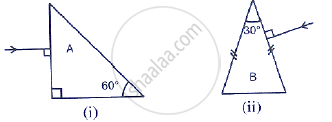
Fig 4.31 below shows a light ray of single colour incident normally on two prisms A and B. In each case draw the path of the ray of light as it enters and emerges out of the prism. Mark the angle wherever necessary.
A coin is places at the bottom of a beaker containing water (refractive index = 4/3) to a depth of 12 cm. By what height the coin appears to be raised when seen from vertically above?
The refractive index of air with respect to glass is expressed as `""_g μ_a=sin i /sin r`.
- Write down a similar expression for aμg in terms of the angles i and r.
- If angle r = 90°, what is the corresponding angle i called?
- What is the physical significance of the angle i in part (b)?
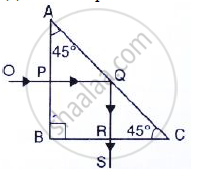
A ray of light OP passes through a right angles prism as shown in the adjacent diagram.
(a) State the angles of incidence at the faces AC and BC.
(b) Name the phenomenon which the ray suffers at the face AC.
While performing the experiment on tracing the path of a ray of light through a rectangular glass slab, in which of the following experimental set-ups is a student likely to get best results? P1 and P2 are the positions of pins fixed by him.
(A) I
(B) II
(C) III
(D) IV
Rahim recorded the following sets of observations while tracing the path of a ray of light passing through a rectangular glass slab for different angles of incidence.
|
S. No. |
Angle of incidence |
Angle of refraction |
Angle of emergence |
|
I |
45° |
41° |
45° |
|
II |
40° |
38° |
38° |
|
III |
45° |
41° |
40° |
|
IV |
41° |
45° |
41° |
The correct observation is recorded at serial number:
(1) I
(2) II
(3) III
(4) IV
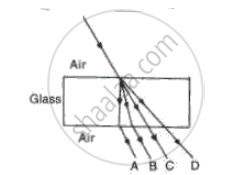
In the fig. name the ray which represents the correct path of light while passing through a glass block.
Which of the following has the highest refractive index:
In an experiment of finding the refractive index of glass, if blue light is replaced by the red light, how will the refractive index of glass change? Give reason in support of your answer.
Choose the correct alternative and rewrite the following:
A glass slab is placed in the path of convergent light. The point of convergence of light
Which colour of light travels fastest in any medium except air?
Does the depth of a tank of water appear to change or remain the same when viewed normally from above?
You are provided with a printed piece of paper. Using this paper how will you differentiate between a convex lens and a concave lens?
The refractive index of air with respect to glass is defined: as gµa = sin i/sin r
If r = 90°, what is the corresponding angle i called?
Two parallel rays of Red and Violet travelling through the air, meet the air-glass boundary as shown in the above figure. Will their paths inside the glass be parallel? Give a reason for your answer.

Write the approximate values of speed of light in (i) air and (ii) glass. Use these values to calculate the refractive index of glass with respect to air.
Draw the ray diagram of a glass slab having medium A and B for the velocity of light ray VA and VB respectively and define Snell's law.
- If VB = 1.5 VA, then which medium is denser?
- What is the refractive index of A with respect to B?
- What is the refractive index of B with respect to A?
Observe the figure and name the ray AB, ray CD, ray GH.

A ray of light strikes the surface of a rectangular glass slab such that the angle of incidence in air is
- 0°,
- 45°.
In each case, draw a diagram to show the path taken by the ray as it passes through the glass slab and emerges from it.
