Advertisements
Advertisements
Question
What do you understand of Einstein’s nature from his conversations with his history teacher, his mathematics teacher and the head teacher?
Advertisements
Solution
A model answer has been provided for students' reference.
It is strongly recommended that students prepare the answer on their own.
Einstein’s behavior seemed to be extremely unruly. He didn't believe in the then prevailing system of education. His nature was a spontaneous one. He found memorising facts and dates quite useless. Ideas lured him more than facts because of which he had a heated argument on education with his history teacher. He was so restless and indifferent to the importance of attending school that he didn't mind not attending it at all. From his conversation with the Maths teacher, we come to know that he was a student who actually had some interest in mathematics, that being the only class in which he paid a lot of attention and never wasted his time. He wasn't open and outright in front of his Mathematics teacher. His behavior had turned mild before his teacher which showed his level of respect and obediance for elders. Later, when he confronts the headmaster, we find him defensive at the beginning and carefree at the end of the meeting.
APPEARS IN
RELATED QUESTIONS
Answer any three of the following questions in 30-40 words each:
(a) What did M. Hamel tell them about the French language? What did he ask them to do and why?
(b) Why does Asokamitran call Subbu, ‘a charitable and improvident man’?
(c) How did the instructor turn Douglas into a swimmer?
(d) Why did Sophie like her brother, Geoff more than any other person?
Answer the following question in 120-150 words:
How does Dr. Cuss's encounter with Griffin end in a disaster?
Read the following extract and complete the activities given below :
A1 Compare the old and new house and complete the table :
| Points | Old House | New House |
| Surrounding | razzle-dazzle | – |
| Size of the house | – | big |
I was thirteen, the year we moved to the Cantonment at Allahabad. In stark contrast to the razzle-dazzle of the city’s commercial areas like Katra and Chowk, the Cantonment was a quiet, orderly place with broad tree-lined roads that still carried the names of long-dead Britishers. Our bungalow was on a sleepy by-lane called MacPherson Road. When we first saw it, my brothers and I were delighted. It was by far the biggest house we had ever lived in. The task of furnishing those huge, echoing rooms daunted mother.
“Is a slightly smaller house not available?” she asked father, “We do not have enough curtains for this place. And the furniture seems a little inadequate. Why did they have to plan the kitchen at such a distance from the dining-room? It is like doing a route march. And who is going to help me keep this place clean and dusted?”
Her misgivings and objections were undoubtedly valid. But, seeing our crestfallen faces, she sighed and gave in. We made extravagant promises to help in the household chores. Keep our rooms tidy. Put away our toys and books. She smiled with amused disbelief, her mind already working out how many meters of curtain-cloth would be needed and so on.
A2 Complete :
Complete the following list of objections that the mother had with the new house :
(i) Inadequate _______
(ii) Do not have _______
(iii) Kitchen at a distance from _______
(iv) A very big _______
A3 Personal response:
Do you agree with the objections raised by the mother? Explain.
Notice these expressions in the text. Infer their meaning from the context.
-
the thought was almost revolting
-
an expanse of pure white serenity
-
a turning-point
-
accepted her seclusion with resignation
-
a veritable bedlam of chirrupings
-
frivolous rebukes
-
the sagging skins of the dilapidated drum
Mention the three phases of the author’s relationship with his grandmother before he left the country to study abroad.
Mention the way in which the sparrows expressed their sorrow when the author’s grandmother died.
Notice the following uses of the word ‘tell’ in the text.
1. Her fingers were busy telling the beads of her rosary.
2. I would tell her English words and little things about Western science and learning.
3. At her age, one could never tell.
4. She told us that her end was near.
Given below are four different senses of the word ‘tell’. Match the meanings to the uses listed above.
1. make something known to someone in spoken or written words
2. count while reciting
3. be sure
4. give information to somebody
Notice the kind of English Tsetan uses while talking to the author. How do you think he picked it up?
Look for a story, a poem and a newspaper article on environment conservation and see how the style of each is different from the other.
There is mention of three communities in the story: the Marathas, the Mughals, the Anglo-Indians. Which language do you think they used within their communities and while speaking to the other groups?
What makes the urgency of the child's demand seem logical?
What does the reference to raw mythology imply?
Make groups and discuss the following:
Did they themselves suffer from those problems/setbacks?
complete the following sentence.
Ajoy reported about ________________.
Make a list of the preparations made for an assault on Tiger Hill.
Throughout the last week of June 1999, 18 Grenadiers ____________.
Behrman did not know anything about the last leaf on the ivy.
Human beings can learn from honey bees ______.
Form suitable groups and discuss the following.
You have heard/read stories of Akbar and Birbal, Tenali Raman, Mulla Nasruddin. Recollect and write down the names of those stories.
Pick out those aspects of a story that you find a common in all their stories.
- Humour
- Supernatural event
- Wisdom
- Suspense
- Magic
- Beauty of Nature
- Wit
- Play upon words
- Sadend
- Violence
The description of the character is given below. Identify the character from the play. Find some sentences which support your choice.
He is smart as well as brave.
What changes in the stage setting would you suggest.
Read aloud/Enact the play.
List five questions from the play which can be answered with 'yes' or 'no'.
To whom is the poem addressed?
Prepare similar word chains using the following ideas.
wind - breeze __________________.
Prepare similar word chains using the following ideas.
sunshine - warm ________________.
Correct the following sentence using facts from the passage.
The great heroes avoided one another.
Write the meaning of doth.
Find the names of the exotic musical instruments and animals mentioned in the poem.
Make as many 5 to 8 letter words as you can within 5 minutes, from the name.
| TESHUMAI TEWINDROW | |||
| Five-letter words | Six-letter words | Seven-letter words | Eight-letter words |
From the poem, find the old word used for each of the following :
- towards
- here
- does
Pick out three examples of interrogation (rhetorical questions) from the poem.
Explain in your own words the point that each one makes.
| Interrogation | Explanation |
| (1) | |
| (2) | |
| (3) |
Say whether you agree or disagree.
The prince had rare, uncommon likes and dislikes.
Form a group of four to six. As a group activity, write a conversation in which a person/a group of person thanks to someone.
Listen carefully and guess how the sentence would end.
When the students saw the question paper, they were ______.
If you were to grow very tiny like a Lilliputian, what are the things you would like to do? Write about any three of these things.
Write a short note on ‘money’.
How was the young seagull’s first attempt to fly?
Where did Chulong catch the bird?
Let no ______ tone be______.
- soft
- vain
- fear
- joy
- love
- heard
- toiled
- mild
- good
- sand
- life
- harsh
Write down the word that alliterate in the poetic line below
Festival of Flowers.
He woke up very late in the morning.
Which mode of transport did Fogg choose?
How can you balance your academic goals and your passion for sports or arts?
The dry earth soaked up the moisture as a hungry puppy laps up milk. It means______.
How does the poet describe the Indian seasons? Write in your own words in about 50 words.
How did Santhosh know that the river was clean?
Where is Jaswantgarh located?
How does Raju help his mother?
The old man put _____ on the mouth of the gourd.
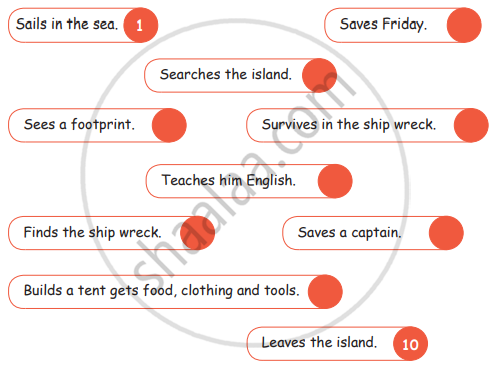
Arrange the actions of Robinson by numbering from 1 to 10.
Match the rhyming words.
| 1. | flow | know |
| 2. | grow | week |
| 3. | seek | blow |
Robinson named the boy______.
Tenzin is from ______.
What did the grandfather announce?
If the fisher draws his net soon, he won’t get ______ in the net.
Replace the bold word/words with a word from the quiver and re-write the sentence –
The teacher said something about his good handwriting. He felt very happy.
The garden Alice saw was
How did the animals know that the king was just a jackal?
Find words from the passage which mean the same as the following.
- a malevolent desire for revenge (para 1)
- tactful (para 2)
- despise (para 3)
Write compound word using the pictures.
 |
+ |  |
| ____________ | ||
