Advertisements
Advertisements
Question
What do you understand about negative acceleration?
Advertisements
Solution
If v < u, i.e. if final velocity is less than initial velocity, the velocity decreases with time and the value of acceleration is negative. It is called negative acceleration. It is also called as retardation (or) deceleration.
APPEARS IN
RELATED QUESTIONS
Give a scientific reason.
When an object falls freely to the ground, its acceleration is uniform.
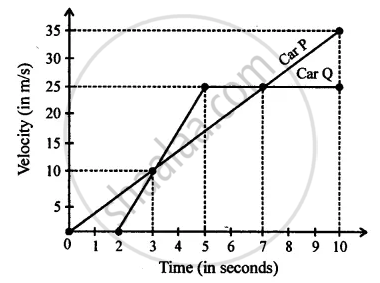
Diagram is given below shows velocity – time graph of car P and Q, starting from the same place and in the same direction. Calculate the Acceleration of car Q between 2 s – 5 s.
A motor bike running at 5 ms−1, picks up a velocity of 30 ms−1 in 5s. Calculate
- acceleration
- distance covered during acceleration.
What happens to the stepwise increasing speed-time graph when the size of each step is made very small?
A body has an acceleration of -3.5 ms-2. What is its retardation?
The graph shows how the velocity of a scooter varies with time in 50 s.
Work out: Deceleration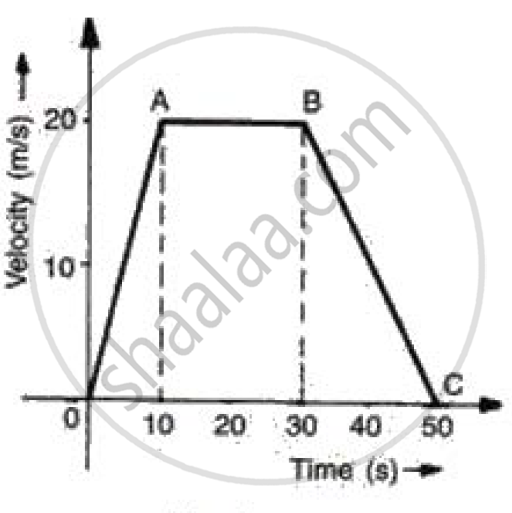
The rate of change of velocity is ______.
Exercise Problem.
A racing car has a uniform acceleration of 4 ms–2. What distance it covers in 10 s after the start?
The slope of a velocity-time graph gives ______.
If a moving body comes to rest, then its acceleration is ______.
