Advertisements
Advertisements
Question
Is the uniform circular motion accelerated? Give reasons for your answer.
Advertisements
Solution
When an object is moving with a constant speed along a circular path, the velocity changes due to the change in direction. Hence it is an accelerated motion.
APPEARS IN
RELATED QUESTIONS
Earth moves around the sun with uniform velocity.
State True or False
The earth moves around the sun with a uniform.
A uniform linear motion is unaccelerated, while a uniform circular motion is an accelerated motion.
Which of the following remains constant in a uniform circular motion, Speed or Velocity, or both?
A particle performs uniform circular motion in a horizontal plane. The radius of the circle is 8 cm. The centripetal force acting on the particle is 15 N. Its kinetic energy is ____________.
Define uniform circular motion and give an example of it. Why is it called accelerated motion?
Earth also moves in circular orbit around sun once every year with on orbital radius of 1.5 × 10¹¹ m. What is the acceleration of earth (or any object on the surface of the earth) towards the centre of the sun? How does this acceleration compare with g = 9.8 m/s2?
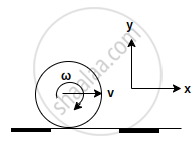
A disc of radius 5 cm rolls on a horizontal surface with linear velocity v = 1`hat"i"` m/s and angular velocity 50 rad/s. Height of particle from ground on rim of disc which has velocity in vertical direction is ______ cm.
Angular speed of hour hand of a clock in degree per second is ______.
A particle moving with uniform speed in a circular path maintains ______.
