Advertisements
Advertisements
Question
What do you infer from Darwin's comment on his indifference to literature as he advanced in years?
Advertisements
Solution
Darwin, a great scientist, known for his work On the Origin of Species, enjoyed literature only until he was 30, as he said. He enjoyed poetic works of Byron, Coleridge, Shelley, etc. immensely. Shakespeare's historical plays gave him much pleasure. However, as he advanced in his age to reach the benchmark of 30, the charm faded and he began losing interest in pictures and music that once gave him great delight. He tried reading poetry and Shakespeare; however, he found it so intolerably dull that it nauseated him. It is surprising that the answer to this change is in Darwin's own statement. His mind had become some kind of a grinding machine to process laws out of facts. It caused atrophy of that part of the brain on which higher tastes depended. It was hard for Darwin to infer it as well and, thus, his romance with literature died away.
APPEARS IN
RELATED QUESTIONS
Read the following extract carefully and complete the activities given below :
A1 Complete the following :
(i) Books were found on the _____________ and ____________.
(ii) The tales are described as ______________ and __________.
|
Have you forgotten? Don't you know?
We'll say it very loud and slow:
THEY ... USED ... TO ... READ! They'd READ and READ,
AND READ and READ, and then proceed
To READ some more. Great Scott! Gadzooks!
One-half of their lives was reading books!
The nursery shelves held books galore!
Books cluttered up the nursery floor!
And in the bedroom, by the bed,
More books were waiting to be read!
Such wondrous, fine, fantastic tales
Of dragons, gypsies, queens, and whales
And treasure isles, and distant shores
Where smugglers rowed with muffled oars,
And pirates wearing purple pants,
And sailing ships and elephants,
And cannibals crouching 'round the pot,
Stirring away at something hot.
(It smells so good, what can it be?
Good gracious, it's Penelope.)
|
Read the extract and do the following activities :
B1 Likes and dislikes :
(i) The child likes eating _______
(ii) The child dislikes eating _______
They won’t eat peas, don’t like your bread -
For something in it crunches;
They gag on fat, the gravy’s gross,
They won’t eat grapes in bunches.
Tomatoes, onions, peppers, fish
Garlic nor cottage cheese;
Oh, it’s a dish uncommon rare
That truly seems to please.
No red sauce may the ice cream have,
“It’s bleeding,” they will say;
And gravely hand it to their mum
To take it to clean away
But let us speak of chocolate cake,
It must be frosted o’er;
They’ll devour three full slabs,
And calmly ask for more.
Oh, I do so always love to eat
With picky little pests,
Whose parents joy to make them
The most undesirable guests!
B2 What message does the poem convey for children?
B3 Pick out two pairs of rhyming words from the poem.
Describe the shifts in the narration of the events as indicated in the three sections of the text. Give a subtitle to each section.
Notice these expression in the text. Infer their meaning from the context.
careered down
Notice this expression in the text. Infer its meaning from the context.
blow-by-blow account
Tick the statement that is true.
The story hinges on a particular historical event.
Tick the statement if its true.
Rajendra Deshpande was a historian.
Discuss the following statement in groups of two pairs, each pair in a group taking opposite points of view.
Reality is what is directly experienced through the senses.
Discuss the following in pairs or in groups of four:
'It is time to realise that unless we modify the established notion of literature as something written, we will silently witness the decline of various Indian oral traditions'
Explain the phrase.
his bending sickle's compass
The quill is the central element of the poem – what does it symbolise?
An acrostic is a poem or a write· up in which the first letter of each line forms a word. when it is read vertically.
For example,
Faithful
Reliable
Inspiring
Encouraging
Noble
Dedicated
With your benchmate / group, complete the acrostic of BELIEVE and FAITH.
(Please note that the words / phrases should be more or less related to the topic. You can use a thesaurus.)
Be certain of
E ......................
L ......................
I ......................
E ......................
V ......................
E ......................
F ......................
A ......................
I ......................
T ......................
H ......................
Breeding worms to use them to convert organic waste into fertilizer is called Vermiculture or vermicomposting.
Find out more about Vermiculture and how you can carry out the same in your garden/backyard, to fertilize your plants at home.
Stories can be told even in the form of poetry. Such poems are called Narrative poems. Narrative poems do not always follow rhythmic patterns of a fixed rhyme scheme. Such poems are written in a style called ‘Free Verse.’
Recall and name some narrative poems you have done/read earlier.
Imagine that you are the peasant. Compose a short prayer to God, after having received the plate of gold. Write it using stylish handwriting.
The special thread for kite - flying is sharpened by adding sugar and glass pieces.
Discuss in your class.
What are the advantages of learning science?
The term 'Anaesthesia' in the poem means - 'The planner gives beautiful pictures of the new modern city'. Now find out what is Amnesia and Hypnosis in the given context.
Draw a picture of the scene described in the poem.
Suggest what you would do in the following situation:
You realise that you no longer want to pursue your studies in the stream you have selected.
Comment on the given statement after reading the given dialogue -
It’s a pity some honest man not to be better of that ________________________________________________.
Discuss the following questions after you have seen a presentation of the ‘ad’.
Will you love your brother or sister only if she’s fair?
Discuss and write 1-2 lines about the following.
How Bushi defeated Yonamine in the wrestling match.
Form pairs. Discuss and prepare a list of things that can be and will be done in future. (5 things) Spot the modal verbs in your answer.
What do the following events/actions tell us about the characters? Discuss.
Sir Ector kneeled before Arthur.
Think and answer:
Why are the sights said to ‘fly’?
Complete the following diagram.

Fill in the blank choosing the appropriate word/idiom from the lesson.
In the examination, I did not know the answer, so I ______.
Discuss the following in group.
What can we do to get rid of bad habits?
What is used to make Rangoli designs?
Read the following passage and answer the questions that follow.
BUNGEE-JUMPING
Bungee jumping is an activity that involves jumping from a tall structure while connected to a long elastic cord. The tall structure is usually a fixed object, such as a building, bridge or crane; but it is also possible to jump from a movable object, such as a hot-air-balloon or helicopter, that has the ability to hover above the ground. The thrill comes from the freefalling and the rebound. When the person jumps, the cord stretches, and the jumper flies upwards again as the cord recoils and continues to oscillate up and down until all the kinetic energy is dissipated.
Jumping Heights, located in Mohan Chatti village, in Rishikesh has been rated as one of the most preferred bungee jumping destinations in India at a height of 83 meters. It is the only place in India where bungee jumping can be done from a fixed platform. This is also India’s only fixed platform Bungee- performed from a professional cantilever, to separate it from entertainment parks, and create instead, an extreme adventure zone. The Bungee has been designed by David Allardice of New Zealand.
The Cantilever platform is built over a rocky cliff over-looking the river Hall, a tributary of River Ganges. Bungee-ing amidst the vastness of nature lends the experience an absolutely breathtaking quality. Jumping heights is well known for its safety measures and experienced staff. It costs around Rs 2500 per jump, a bit expensive, but totally worth the experience. The Bungee jumping experience has been set amidst the astoundingly stunning landscape of Rishikesh. To Bungee jump, one must be at least 12 years and should weigh between 40-110 kg.
Questions
- What is Bungee Jumping?
- Can Bungee be performed from a movable object? How?
- When do you think Bungee becomes thrilling?
- What is the experience when one falls off the platform?
- Where is the Bungee jumping point located in India?
- What is the minimum age to Bungee jump?
Marco Polo, Christopher Columbus, Ibn Battuta, Amerigo Vespucci, Xuanzang, Ferdinand Magellan, Bartolomeu Dias, Herodotus, Captain James Cook, Vasco De Gama.
What is common among these individuals? Browse Internet or refer books and share some information about them.
Read the following line from the poem and answer the question that follow.
So let the way wind up the hill or down, O'er rough or smooth, the journey will be joy: Still seeking what I sought when but a boy, New friendship, high adventure, and a crown,
- How is the way of life?
- How should be the journey of life?
- What did the poet seek as a boy?
Identify the character or speaker.
He imprisoned the spirits in the bodies of large trees.
The taxi driver took away the narrator’s suitcase.
What do you need to learn to live a good life in this world?
Identify the character/speaker.
I'll see you later at the Queen's croquet game.
Identify the character/speaker.
You may stay if you answer my riddle.
Read the line and answer the question.
And all I ask is a windy day with the white clouds flying
Why does the poet ask for a windy day?
Work in pairs and answer the following.
Pick out the alliterated words.
A sea turtle camouflages its nest by tossing sand on it to ______.
Mother called ______.
In Mars ______ Earth days make a year.
How did the aliens know the boys' language?
How do we see the earthworm often?
Rosy ______a bicycle.
Choose the correct option from the given homophones.
The wind ______off the leaves.
Match the words with the pictures.
| Robinson |  |
| cannibals |  |
| Friday |  |
| footprint |  |
Choose the best answer.
Suddenly there was a______.
Match the rhyming words.
| pale | knows |
| boat | gale |
| goes | goat |
Where is Keeraikuppam located?
How does a friend support us?
Match the following and write the new word.
| 1. | pre | continue |
| 2. | dis | familiar |
| 3. | un | open |
| 4. | re | view |
A Shepherd had a _______.
Who is responsible for the society?
Name the animal and sound it makes.
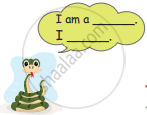
Mugund did not cut the raw wood.
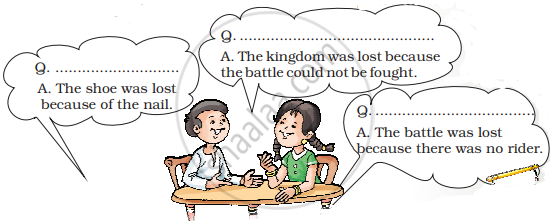
Read the poem.
For Want of a Nail
For want of a nail, the shoe was lost,
For want of a shoe the horse was lost,
For want of a horse, the rider was lost,
For want of a rider, the battle was lost,
For want of a battle, the kingdom was lost,
And all for the want of a horseshoe nail!
[traditional rhyme]
Now form questions for the answers given in the speech bubbles.
Circle the words where you get a zzzzz sound. One is done for you.
| honeybees | |||
| price | prize | maze | face |
| rice | rise | blaze | fizz |
| lazy | lacy | busy | racy |
| raise | rays | race | ace |
| chase | this | these | frosty |
William Shakespeare was one of the greatest playwrights of all time. He lived in the 16th century. Many Shakespearean plays have been written in the short-story form. Find out the names of at least 5 of Shakespearean plays.
Example: Romeo and Juliet
