Advertisements
Advertisements
Question
The midpoints of the sides of a square of side 1 are joined to form a new square. This procedure is repeated indefinitely. Find the sum of the perimeters of all the squares
Advertisements
Solution
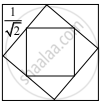
Perimeter of 1st square = 4
Perimeter of 2nd square = `4(1/sqrt(2))`
Perimeter of 3rd square = `4(1/2)`
and so on.
∴ Sum of the perimeters of all the squares
= `4 + 4(1/sqrt(2)) + 4(1/2) + ...`
= `4(1 + 1/sqrt(2) + (1/sqrt(2))^2 + ...)`
The terms `1,1/sqrt(2), (1/sqrt(2))^2, ...` are in G.P.
∴ a = 1, r = `1/sqrt(2)`
Since, |r| = `|1/sqrt(2)| < 1`
∴ sum to infinity exists.
∴ Sum of the perimeters of all the squares
= `4(1/(1 - 1/sqrt(2)))`
= `(4sqrt(2))/(sqrt(2) - 1)`
APPEARS IN
RELATED QUESTIONS
The 4th term of a G.P. is square of its second term, and the first term is –3. Determine its 7thterm.
Which term of the following sequence:
`2, 2sqrt2, 4,.... is 128`
The sum of first three terms of a G.P. is `39/10` and their product is 1. Find the common ratio and the terms.
Show that the products of the corresponding terms of the sequences a, ar, ar2, …arn – 1 and A, AR, AR2, … `AR^(n-1)` form a G.P, and find the common ratio
Let S be the sum, P the product and R the sum of reciprocals of n terms in a G.P. Prove that P2Rn = Sn
Find the sum of the following geometric progression:
4, 2, 1, 1/2 ... to 10 terms.
Find the sum of the following geometric series:
1, −a, a2, −a3, ....to n terms (a ≠ 1)
Evaluate the following:
\[\sum^{11}_{n = 1} (2 + 3^n )\]
Find the sum of the following serie:
5 + 55 + 555 + ... to n terms;
Find the sum of the following series:
0.5 + 0.55 + 0.555 + ... to n terms.
Find the sum of the following series:
0.6 + 0.66 + 0.666 + .... to n terms
The 4th and 7th terms of a G.P. are \[\frac{1}{27} \text { and } \frac{1}{729}\] respectively. Find the sum of n terms of the G.P.
Find the sum of the following series to infinity:
`1/3+1/5^2 +1/3^3+1/5^4 + 1/3^5 + 1/56+ ...infty`
Find the sum of the terms of an infinite decreasing G.P. in which all the terms are positive, the first term is 4, and the difference between the third and fifth term is equal to 32/81.
Find the rational numbers having the following decimal expansion:
\[0 . \overline3\]
If S denotes the sum of an infinite G.P. S1 denotes the sum of the squares of its terms, then prove that the first term and common ratio are respectively
\[\frac{2S S_1}{S^2 + S_1}\text { and } \frac{S^2 - S_1}{S^2 + S_1}\]
If a, b, c are in G.P., prove that:
a (b2 + c2) = c (a2 + b2)
If a, b, c, d are in G.P., prove that:
(b + c) (b + d) = (c + a) (c + d)
If a, b, c are in G.P., prove that the following is also in G.P.:
a2 + b2, ab + bc, b2 + c2
If a, b, c, d are in G.P., prove that:
(a2 + b2), (b2 + c2), (c2 + d2) are in G.P.
If a, b, c, d are in G.P., prove that:
(a2 + b2 + c2), (ab + bc + cd), (b2 + c2 + d2) are in G.P.
If pth, qth and rth terms of an A.P. and G.P. are both a, b and c respectively, show that \[a^{b - c} b^{c - a} c^{a - b} = 1\]
If pth, qth and rth terms of a G.P. re x, y, z respectively, then write the value of xq − r yr − pzp − q.
Write the product of n geometric means between two numbers a and b.
Check whether the following sequence is G.P. If so, write tn.
2, 6, 18, 54, …
If for a sequence, tn = `(5^("n"-3))/(2^("n"-3))`, show that the sequence is a G.P. Find its first term and the common ratio
The numbers 3, x, and x + 6 form are in G.P. Find nth term
Mosquitoes are growing at a rate of 10% a year. If there were 200 mosquitoes in the beginning. Write down the number of mosquitoes after 3 years.
Find the sum to n terms of the sequence.
0.2, 0.02, 0.002, ...
If Sn, S2n, S3n are the sum of n, 2n, 3n terms of a G.P. respectively, then verify that Sn (S3n – S2n) = (S2n – Sn)2.
If the A.M. of two numbers exceeds their G.M. by 2 and their H.M. by `18/5`, find the numbers.
Select the correct answer from the given alternative.
If common ratio of the G.P is 5, 5th term is 1875, the first term is -
Answer the following:
Find the nth term of the sequence 0.6, 0.66, 0.666, 0.6666, ...
Answer the following:
If for a G.P. first term is (27)2 and seventh term is (8)2, find S8
Answer the following:
If p, q, r, s are in G.P., show that (pn + qn), (qn + rn) , (rn + sn) are also in G.P.
The third term of a G.P. is 4, the product of the first five terms is ______.
Find a G.P. for which sum of the first two terms is – 4 and the fifth term is 4 times the third term.
The sum of the infinite series `1 + 5/6 + 12/6^2 + 22/6^3 + 35/6^4 + 51/6^5 + 70/6^6 + ....` is equal to ______.
