Advertisements
Advertisements
प्रश्न
The midpoints of the sides of a square of side 1 are joined to form a new square. This procedure is repeated indefinitely. Find the sum of the perimeters of all the squares
Advertisements
उत्तर
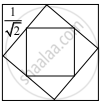
Perimeter of 1st square = 4
Perimeter of 2nd square = `4(1/sqrt(2))`
Perimeter of 3rd square = `4(1/2)`
and so on.
∴ Sum of the perimeters of all the squares
= `4 + 4(1/sqrt(2)) + 4(1/2) + ...`
= `4(1 + 1/sqrt(2) + (1/sqrt(2))^2 + ...)`
The terms `1,1/sqrt(2), (1/sqrt(2))^2, ...` are in G.P.
∴ a = 1, r = `1/sqrt(2)`
Since, |r| = `|1/sqrt(2)| < 1`
∴ sum to infinity exists.
∴ Sum of the perimeters of all the squares
= `4(1/(1 - 1/sqrt(2)))`
= `(4sqrt(2))/(sqrt(2) - 1)`
APPEARS IN
संबंधित प्रश्न
Evaluate `sum_(k=1)^11 (2+3^k )`
The sum of first three terms of a G.P. is 16 and the sum of the next three terms is 128. Determine the first term, the common ratio and the sum to n terms of the G.P.
If a, b, c and d are in G.P. show that (a2 + b2 + c2) (b2 + c2 + d2) = (ab + bc + cd)2 .
A G.P. consists of an even number of terms. If the sum of all the terms is 5 times the sum of terms occupying odd places, then find its common ratio.
Let S be the sum, P the product and R the sum of reciprocals of n terms in a G.P. Prove that P2Rn = Sn
Show that one of the following progression is a G.P. Also, find the common ratio in case:1/2, 1/3, 2/9, 4/27, ...
Find the 4th term from the end of the G.P.
Which term of the G.P. :
\[2, 2\sqrt{2}, 4, . . .\text { is }128 ?\]
If the G.P.'s 5, 10, 20, ... and 1280, 640, 320, ... have their nth terms equal, find the value of n.
If 5th, 8th and 11th terms of a G.P. are p. q and s respectively, prove that q2 = ps.
The sum of three numbers in G.P. is 21 and the sum of their squares is 189. Find the numbers.
Find the sum of the following geometric progression:
1, 3, 9, 27, ... to 8 terms;
Find the sum of the following geometric series:
`3/5 + 4/5^2 + 3/5^3 + 4/5^4 + ....` to 2n terms;
The 4th and 7th terms of a G.P. are \[\frac{1}{27} \text { and } \frac{1}{729}\] respectively. Find the sum of n terms of the G.P.
Find the sum of the following serie to infinity:
`2/5 + 3/5^2 +2/5^3 + 3/5^4 + ... ∞.`
The sum of first two terms of an infinite G.P. is 5 and each term is three times the sum of the succeeding terms. Find the G.P.
Find k such that k + 9, k − 6 and 4 form three consecutive terms of a G.P.
The sum of three numbers a, b, c in A.P. is 18. If a and b are each increased by 4 and c is increased by 36, the new numbers form a G.P. Find a, b, c.
If a, b, c are in G.P., prove that:
a (b2 + c2) = c (a2 + b2)
If a, b, c, d are in G.P., prove that:
(b + c) (b + d) = (c + a) (c + d)
If a, b, c are three distinct real numbers in G.P. and a + b + c = xb, then prove that either x< −1 or x > 3.
Write the product of n geometric means between two numbers a and b.
If S be the sum, P the product and R be the sum of the reciprocals of n terms of a GP, then P2 is equal to
The nth term of a G.P. is 128 and the sum of its n terms is 255. If its common ratio is 2, then its first term is ______.
If x = (43) (46) (46) (49) .... (43x) = (0.0625)−54, the value of x is
Check whether the following sequence is G.P. If so, write tn.
2, 6, 18, 54, …
Check whether the following sequence is G.P. If so, write tn.
`sqrt(5), 1/sqrt(5), 1/(5sqrt(5)), 1/(25sqrt(5))`, ...
For the G.P. if a = `7/243`, r = 3 find t6.
The numbers 3, x, and x + 6 form are in G.P. Find nth term
Mosquitoes are growing at a rate of 10% a year. If there were 200 mosquitoes in the beginning. Write down the number of mosquitoes after 10 years.
For the following G.P.s, find Sn.
p, q, `"q"^2/"p", "q"^3/"p"^2,` ...
The value of a house appreciates 5% per year. How much is the house worth after 6 years if its current worth is ₹ 15 Lac. [Given: (1.05)5 = 1.28, (1.05)6 = 1.34]
Determine whether the sum to infinity of the following G.P.s exist, if exists find them:
`-3, 1, (-1)/3, 1/9, ...`
Determine whether the sum to infinity of the following G.P.s exist, if exists find them:
9, 8.1, 7.29, ...
Answer the following:
In a G.P., the fourth term is 48 and the eighth term is 768. Find the tenth term
Answer the following:
Find the sum of the first 5 terms of the G.P. whose first term is 1 and common ratio is `2/3`
Answer the following:
For a sequence Sn = 4(7n – 1) verify that the sequence is a G.P.
Answer the following:
Find `sum_("r" = 1)^"n" (2/3)^"r"`
In a G.P. of even number of terms, the sum of all terms is 5 times the sum of the odd terms. The common ratio of the G.P. is ______.
