Advertisements
Advertisements
प्रश्न
The midpoints of the sides of a square of side 1 are joined to form a new square. This procedure is repeated indefinitely. Find the sum of the areas of all the squares
Advertisements
उत्तर
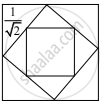
Area of the 1st square = 12
Area of the 2nd square = `(1/sqrt2)^2`
Area of the 3rd square = `(1/2)^2`
and so on
∴ Sum of the areas of all the squares
= `1^2+(1/sqrt2)^2+(1/2)^2+...`
= `1+1/2+1/4+...`
∴ a = 1, r = `1/2`
Since, |r| = `|1/2|<1`
∴ sum to infinity exists.
∴ Sum of the areas of all the squares = `1/(1-1/2)` = 2
APPEARS IN
संबंधित प्रश्न
Find the 12th term of a G.P. whose 8th term is 192 and the common ratio is 2.
Find the sum to indicated number of terms of the geometric progressions `sqrt7, sqrt21,3sqrt7`...n terms.
The sum of first three terms of a G.P. is `39/10` and their product is 1. Find the common ratio and the terms.
Find the value of n so that `(a^(n+1) + b^(n+1))/(a^n + b^n)` may be the geometric mean between a and b.
The seventh term of a G.P. is 8 times the fourth term and 5th term is 48. Find the G.P.
Find the sum of the following geometric series:
\[\frac{2}{9} - \frac{1}{3} + \frac{1}{2} - \frac{3}{4} + . . . \text { to 5 terms };\]
Evaluate the following:
\[\sum^{11}_{n = 1} (2 + 3^n )\]
Evaluate the following:
\[\sum^{10}_{n = 2} 4^n\]
Find the sum of the following serie to infinity:
`2/5 + 3/5^2 +2/5^3 + 3/5^4 + ... ∞.`
Find the sum of the following series to infinity:
`1/3+1/5^2 +1/3^3+1/5^4 + 1/3^5 + 1/56+ ...infty`
Find the sum of the terms of an infinite decreasing G.P. in which all the terms are positive, the first term is 4, and the difference between the third and fifth term is equal to 32/81.
Show that in an infinite G.P. with common ratio r (|r| < 1), each term bears a constant ratio to the sum of all terms that follow it.
If a, b, c are in A.P. and a, b, d are in G.P., show that a, (a − b), (d − c) are in G.P.
Insert 5 geometric means between 16 and \[\frac{1}{4}\] .
Insert 5 geometric means between \[\frac{32}{9}\text{and}\frac{81}{2}\] .
Find the geometric means of the following pairs of number:
2 and 8
If (p + q)th and (p − q)th terms of a G.P. are m and n respectively, then write is pth term.
If in an infinite G.P., first term is equal to 10 times the sum of all successive terms, then its common ratio is
If S be the sum, P the product and R be the sum of the reciprocals of n terms of a GP, then P2 is equal to
The fractional value of 2.357 is
If the sum of first two terms of an infinite GP is 1 every term is twice the sum of all the successive terms, then its first term is
The nth term of a G.P. is 128 and the sum of its n terms is 255. If its common ratio is 2, then its first term is ______.
If x is positive, the sum to infinity of the series \[\frac{1}{1 + x} - \frac{1 - x}{(1 + x )^2} + \frac{(1 - x )^2}{(1 + x )^3} - \frac{(1 - x )^3}{(1 + x )^4} + . . . . . . is\]
Check whether the following sequence is G.P. If so, write tn.
1, –5, 25, –125 …
For the G.P. if a = `7/243`, r = 3 find t6.
A ball is dropped from a height of 80 ft. The ball is such that it rebounds `(3/4)^"th"` of the height it has fallen. How high does the ball rebound on 6th bounce? How high does the ball rebound on nth bounce?
Mosquitoes are growing at a rate of 10% a year. If there were 200 mosquitoes in the beginning. Write down the number of mosquitoes after n years.
For the following G.P.s, find Sn
3, 6, 12, 24, ...
For a G.P. sum of first 3 terms is 125 and sum of next 3 terms is 27, find the value of r
If S, P, R are the sum, product, and sum of the reciprocals of n terms of a G.P. respectively, then verify that `["S"/"R"]^"n"` = P2
If one invests Rs. 10,000 in a bank at a rate of interest 8% per annum, how long does it take to double the money by compound interest? [(1.08)5 = 1.47]
Determine whether the sum to infinity of the following G.P.s exist, if exists find them:
`2, 4/3, 8/9, 16/27, ...`
Answer the following:
For a sequence Sn = 4(7n – 1) verify that the sequence is a G.P.
Answer the following:
Find the nth term of the sequence 0.6, 0.66, 0.666, 0.6666, ...
Answer the following:
Find k so that k – 1, k, k + 2 are consecutive terms of a G.P.
Answer the following:
If pth, qth and rth terms of a G.P. are x, y, z respectively. Find the value of xq–r .yr–p .zp–q
Let S be the sum, P be the product and R be the sum of the reciprocals of 3 terms of a G.P. Then P2 R3 : S3 is equal to ______.
If pth, qth, and rth terms of an A.P. and G.P. are both a, b and c respectively, show that ab–c . bc – a . ca – b = 1
If `e^((cos^2x + cos^4x + cos^6x + ...∞)log_e2` satisfies the equation t2 – 9t + 8 = 0, then the value of `(2sinx)/(sinx + sqrt(3)cosx)(0 < x ,< π/2)` is ______.
For an increasing G.P. a1, a2 , a3 ........., an, if a6 = 4a4, a9 – a7 = 192, then the value of `sum_(i = 1)^∞ 1/a_i` is ______.
