Advertisements
Advertisements
प्रश्न
The midpoints of the sides of a square of side 1 are joined to form a new square. This procedure is repeated indefinitely. Find the sum of the areas of all the squares
Advertisements
उत्तर
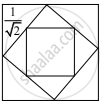
Area of the 1st square = 12
Area of the 2nd square = `(1/sqrt2)^2`
Area of the 3rd square = `(1/2)^2`
and so on
∴ Sum of the areas of all the squares
= `1^2+(1/sqrt2)^2+(1/2)^2+...`
= `1+1/2+1/4+...`
∴ a = 1, r = `1/2`
Since, |r| = `|1/2|<1`
∴ sum to infinity exists.
∴ Sum of the areas of all the squares = `1/(1-1/2)` = 2
APPEARS IN
संबंधित प्रश्न
Show that the products of the corresponding terms of the sequences a, ar, ar2, …arn – 1 and A, AR, AR2, … `AR^(n-1)` form a G.P, and find the common ratio
If the pth, qth and rth terms of a G.P. are a, b and c, respectively. Prove that `a^(q - r) b^(r-p) c^(p-q) = 1`.
Show that the ratio of the sum of first n terms of a G.P. to the sum of terms from (n + 1)th to (2n)th term is `1/r^n`.
The sum of some terms of G.P. is 315 whose first term and the common ratio are 5 and 2, respectively. Find the last term and the number of terms.
If a, b, c are in A.P,; b, c, d are in G.P and ` 1/c, 1/d,1/e` are in A.P. prove that a, c, e are in G.P.
The fourth term of a G.P. is 27 and the 7th term is 729, find the G.P.
The 4th term of a G.P. is square of its second term, and the first term is − 3. Find its 7th term.
Find the sum of the following geometric series:
\[\frac{2}{9} - \frac{1}{3} + \frac{1}{2} - \frac{3}{4} + . . . \text { to 5 terms };\]
Find the sum of the following serie:
5 + 55 + 555 + ... to n terms;
How many terms of the sequence \[\sqrt{3}, 3, 3\sqrt{3},\] ... must be taken to make the sum \[39 + 13\sqrt{3}\] ?
The ratio of the sum of the first three terms to that of the first 6 terms of a G.P. is 125 : 152. Find the common ratio.
If S1, S2, ..., Sn are the sums of n terms of n G.P.'s whose first term is 1 in each and common ratios are 1, 2, 3, ..., n respectively, then prove that S1 + S2 + 2S3 + 3S4 + ... (n − 1) Sn = 1n + 2n + 3n + ... + nn.
A G.P. consists of an even number of terms. If the sum of all the terms is 5 times the sum of the terms occupying the odd places. Find the common ratio of the G.P.
Find an infinite G.P. whose first term is 1 and each term is the sum of all the terms which follow it.
The sum of first two terms of an infinite G.P. is 5 and each term is three times the sum of the succeeding terms. Find the G.P.
The sum of three numbers in G.P. is 56. If we subtract 1, 7, 21 from these numbers in that order, we obtain an A.P. Find the numbers.
If a, b, c are in G.P., prove that:
\[\frac{(a + b + c )^2}{a^2 + b^2 + c^2} = \frac{a + b + c}{a - b + c}\]
If a, b, c, d are in G.P., prove that:
(a2 − b2), (b2 − c2), (c2 − d2) are in G.P.
If x = (43) (46) (46) (49) .... (43x) = (0.0625)−54, the value of x is
For the G.P. if a = `7/243`, r = 3 find t6.
If p, q, r, s are in G.P. show that p + q, q + r, r + s are also in G.P.
The numbers 3, x, and x + 6 form are in G.P. Find 20th term.
The numbers 3, x, and x + 6 form are in G.P. Find nth term
The numbers x − 6, 2x and x2 are in G.P. Find 1st term
For the following G.P.s, find Sn
0.7, 0.07, 0.007, .....
Express the following recurring decimal as a rational number:
`2.bar(4)`
Express the following recurring decimal as a rational number:
`51.0bar(2)`
Find `sum_("r" = 0)^oo (-8)(-1/2)^"r"`
Answer the following:
In a G.P., the fourth term is 48 and the eighth term is 768. Find the tenth term
Answer the following:
For a G.P. a = `4/3` and t7 = `243/1024`, find the value of r
Answer the following:
Find k so that k – 1, k, k + 2 are consecutive terms of a G.P.
Answer the following:
If for a G.P. first term is (27)2 and seventh term is (8)2, find S8
Let S be the sum, P be the product and R be the sum of the reciprocals of 3 terms of a G.P. Then P2 R3 : S3 is equal to ______.
If pth, qth, and rth terms of an A.P. and G.P. are both a, b and c respectively, show that ab–c . bc – a . ca – b = 1
The third term of a G.P. is 4, the product of the first five terms is ______.
The sum of infinite number of terms of a decreasing G.P. is 4 and the sum of the terms to m squares of its terms to infinity is `16/3`, then the G.P. is ______.
If in a geometric progression {an}, a1 = 3, an = 96 and Sn = 189, then the value of n is ______.
