Advertisements
Advertisements
प्रश्न
The midpoints of the sides of a square of side 1 are joined to form a new square. This procedure is repeated indefinitely. Find the sum of the perimeters of all the squares
Advertisements
उत्तर
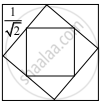
Perimeter of 1st square = 4
Perimeter of 2nd square = `4(1/sqrt(2))`
Perimeter of 3rd square = `4(1/2)`
and so on.
∴ Sum of the perimeters of all the squares
= `4 + 4(1/sqrt(2)) + 4(1/2) + ...`
= `4(1 + 1/sqrt(2) + (1/sqrt(2))^2 + ...)`
The terms `1,1/sqrt(2), (1/sqrt(2))^2, ...` are in G.P.
∴ a = 1, r = `1/sqrt(2)`
Since, |r| = `|1/sqrt(2)| < 1`
∴ sum to infinity exists.
∴ Sum of the perimeters of all the squares
= `4(1/(1 - 1/sqrt(2)))`
= `(4sqrt(2))/(sqrt(2) - 1)`
APPEARS IN
संबंधित प्रश्न
Find the sum to indicated number of terms of the geometric progressions `sqrt7, sqrt21,3sqrt7`...n terms.
Show that the products of the corresponding terms of the sequences a, ar, ar2, …arn – 1 and A, AR, AR2, … `AR^(n-1)` form a G.P, and find the common ratio
The sum of two numbers is 6 times their geometric mean, show that numbers are in the ratio `(3 + 2sqrt2) ":" (3 - 2sqrt2)`.
Show that one of the following progression is a G.P. Also, find the common ratio in case:
4, −2, 1, −1/2, ...
Which term of the G.P. :
\[\sqrt{2}, \frac{1}{\sqrt{2}}, \frac{1}{2\sqrt{2}}, \frac{1}{4\sqrt{2}}, . . . \text { is }\frac{1}{512\sqrt{2}}?\]
Which term of the G.P. :
\[2, 2\sqrt{2}, 4, . . .\text { is }128 ?\]
If 5th, 8th and 11th terms of a G.P. are p. q and s respectively, prove that q2 = ps.
In a GP the 3rd term is 24 and the 6th term is 192. Find the 10th term.
The sum of first three terms of a G.P. is 13/12 and their product is − 1. Find the G.P.
Find the sum of the following geometric progression:
2, 6, 18, ... to 7 terms;
Find the sum of the following geometric series:
\[\sqrt{2} + \frac{1}{\sqrt{2}} + \frac{1}{2\sqrt{2}} + . . .\text { to 8 terms };\]
Evaluate the following:
\[\sum^{11}_{n = 1} (2 + 3^n )\]
Evaluate the following:
\[\sum^n_{k = 1} ( 2^k + 3^{k - 1} )\]
Find the sum of the following series:
0.6 + 0.66 + 0.666 + .... to n terms
Find the sum of the following serie to infinity:
8 + \[4\sqrt{2}\] + 4 + ... ∞
Find the rational numbers having the following decimal expansion:
\[3 . 5\overline 2\]
If a, b, c are in G.P., prove that \[\frac{1}{\log_a m}, \frac{1}{\log_b m}, \frac{1}{\log_c m}\] are in A.P.
If a, b, c are in A.P. and a, b, d are in G.P., show that a, (a − b), (d − c) are in G.P.
Insert 5 geometric means between 16 and \[\frac{1}{4}\] .
If A1, A2 be two AM's and G1, G2 be two GM's between a and b, then find the value of \[\frac{A_1 + A_2}{G_1 G_2}\]
If S be the sum, P the product and R be the sum of the reciprocals of n terms of a GP, then P2 is equal to
If A be one A.M. and p, q be two G.M.'s between two numbers, then 2 A is equal to
If p, q be two A.M.'s and G be one G.M. between two numbers, then G2 =
If x = (43) (46) (46) (49) .... (43x) = (0.0625)−54, the value of x is
Given that x > 0, the sum \[\sum^\infty_{n = 1} \left( \frac{x}{x + 1} \right)^{n - 1}\] equals
Check whether the following sequence is G.P. If so, write tn.
3, 4, 5, 6, …
For the G.P. if a = `7/243`, r = 3 find t6.
If p, q, r, s are in G.P. show that p + q, q + r, r + s are also in G.P.
Mosquitoes are growing at a rate of 10% a year. If there were 200 mosquitoes in the beginning. Write down the number of mosquitoes after n years.
If one invests Rs. 10,000 in a bank at a rate of interest 8% per annum, how long does it take to double the money by compound interest? [(1.08)5 = 1.47]
A ball is dropped from a height of 10m. It bounces to a height of 6m, then 3.6m and so on. Find the total distance travelled by the ball
Select the correct answer from the given alternative.
Sum to infinity of a G.P. 5, `-5/2, 5/4, -5/8, 5/16,...` is –
Answer the following:
Find the nth term of the sequence 0.6, 0.66, 0.666, 0.6666, ...
Answer the following:
If for a G.P. first term is (27)2 and seventh term is (8)2, find S8
Answer the following:
If p, q, r, s are in G.P., show that (p2 + q2 + r2) (q2 + r2 + s2) = (pq + qr + rs)2
Let `{a_n}_(n = 0)^∞` be a sequence such that a0 = a1 = 0 and an+2 = 2an+1 – an + 1 for all n ≥ 0. Then, `sum_(n = 2)^∞ a^n/7^n` is equal to ______.
If 0 < x, y, a, b < 1, then the sum of the infinite terms of the series `sqrt(x)(sqrt(a) + sqrt(x)) + sqrt(x)(sqrt(ab) + sqrt(xy)) + sqrt(x)(bsqrt(a) + ysqrt(x)) + ...` is ______.
Let A1, A2, A3, .... be an increasing geometric progression of positive real numbers. If A1A3A5A7 = `1/1296` and A2 + A4 = `7/36`, then the value of A6 + A8 + A10 is equal to ______.
