Advertisements
Advertisements
Question
The midpoints of the sides of a square of side 1 are joined to form a new square. This procedure is repeated indefinitely. Find the sum of the areas of all the squares
Advertisements
Solution
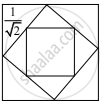
Area of the 1st square = 12
Area of the 2nd square = `(1/sqrt2)^2`
Area of the 3rd square = `(1/2)^2`
and so on
∴ Sum of the areas of all the squares
= `1^2+(1/sqrt2)^2+(1/2)^2+...`
= `1+1/2+1/4+...`
∴ a = 1, r = `1/2`
Since, |r| = `|1/2|<1`
∴ sum to infinity exists.
∴ Sum of the areas of all the squares = `1/(1-1/2)` = 2
APPEARS IN
RELATED QUESTIONS
Find the sum to 20 terms in the geometric progression 0.15, 0.015, 0.0015,…
The sum of first three terms of a G.P. is `39/10` and their product is 1. Find the common ratio and the terms.
Find four numbers forming a geometric progression in which third term is greater than the first term by 9, and the second term is greater than the 4th by 18.
If the pth, qth and rth terms of a G.P. are a, b and c, respectively. Prove that `a^(q - r) b^(r-p) c^(p-q) = 1`.
The sum of some terms of G.P. is 315 whose first term and the common ratio are 5 and 2, respectively. Find the last term and the number of terms.
Find:
the ninth term of the G.P. 1, 4, 16, 64, ...
Find :
the 8th term of the G.P. 0.3, 0.06, 0.012, ...
Find :
nth term of the G.P.
\[\sqrt{3}, \frac{1}{\sqrt{3}}, \frac{1}{3\sqrt{3}}, . . .\]
Which term of the G.P. :
\[\frac{1}{3}, \frac{1}{9}, \frac{1}{27} . . \text { . is } \frac{1}{19683} ?\]
Which term of the progression 18, −12, 8, ... is \[\frac{512}{729}\] ?
The 4th term of a G.P. is square of its second term, and the first term is − 3. Find its 7th term.
The sum of three numbers in G.P. is 14. If the first two terms are each increased by 1 and the third term decreased by 1, the resulting numbers are in A.P. Find the numbers.
Find the sum of the following geometric series:
\[\sqrt{2} + \frac{1}{\sqrt{2}} + \frac{1}{2\sqrt{2}} + . . .\text { to 8 terms };\]
Find the sum of the following geometric series:
(x +y) + (x2 + xy + y2) + (x3 + x2y + xy2 + y3) + ... to n terms;
How many terms of the sequence \[\sqrt{3}, 3, 3\sqrt{3},\] ... must be taken to make the sum \[39 + 13\sqrt{3}\] ?
The 4th and 7th terms of a G.P. are \[\frac{1}{27} \text { and } \frac{1}{729}\] respectively. Find the sum of n terms of the G.P.
Find the sum :
\[\sum^{10}_{n = 1} \left[ \left( \frac{1}{2} \right)^{n - 1} + \left( \frac{1}{5} \right)^{n + 1} \right] .\]
Find the sum of the following serie to infinity:
\[1 - \frac{1}{3} + \frac{1}{3^2} - \frac{1}{3^3} + \frac{1}{3^4} + . . . \infty\]
Find the rational numbers having the following decimal expansion:
\[0 . 6\overline8\]
Show that in an infinite G.P. with common ratio r (|r| < 1), each term bears a constant ratio to the sum of all terms that follow it.
Three numbers are in A.P. and their sum is 15. If 1, 3, 9 be added to them respectively, they form a G.P. Find the numbers.
If a, b, c are in G.P., then prove that:
If a, b, c are in A.P., b,c,d are in G.P. and \[\frac{1}{c}, \frac{1}{d}, \frac{1}{e}\] are in A.P., prove that a, c,e are in G.P.
The value of 91/3 . 91/9 . 91/27 ... upto inf, is
The numbers x − 6, 2x and x2 are in G.P. Find 1st term
For a G.P. a = 2, r = `-2/3`, find S6
For a G.P. If t3 = 20 , t6 = 160 , find S7
If one invests Rs. 10,000 in a bank at a rate of interest 8% per annum, how long does it take to double the money by compound interest? [(1.08)5 = 1.47]
Determine whether the sum to infinity of the following G.P.s exist, if exists find them:
`2, 4/3, 8/9, 16/27, ...`
Express the following recurring decimal as a rational number:
`2.bar(4)`
Express the following recurring decimal as a rational number:
`2.3bar(5)`
The sum of an infinite G.P. is 5 and the sum of the squares of these terms is 15 find the G.P.
Find : `sum_("r" = 1)^oo 4(0.5)^"r"`
Answer the following:
For a sequence Sn = 4(7n – 1) verify that the sequence is a G.P.
Answer the following:
Find k so that k – 1, k, k + 2 are consecutive terms of a G.P.
The third term of a G.P. is 4, the product of the first five terms is ______.
For an increasing G.P. a1, a2 , a3 ........., an, if a6 = 4a4, a9 – a7 = 192, then the value of `sum_(i = 1)^∞ 1/a_i` is ______.
