Advertisements
Advertisements
Question
The electronic configurations of two elements A and B are given below:
| A | 2, 6 |
| B | 2, 8, 1 |
(a) What type of chemical bond is formed between the two atoms of A?
(b) What type of chemical bond will be formed between the atoms of A and B?
Advertisements
Solution
(a) Two atoms of A can form covalent bond between them by sharing two electrons from each atom. This allows them to complete their octets and get stabilised. The molecule so formed is A=A.
(b) Atoms A and B may react to form ionic bond by transfer of two electrons from two atoms of B to form an ionic compound AB2.
APPEARS IN
RELATED QUESTIONS
Why covalent compounds are different from ionic compounds?
Elements forming ionic compounds attain noble gas configuration by either gaining or losing electrons from their outermost shells. Give reason to explain why carbon cannot attain noble gas configuration in this manner to form its compounds.
What would be the electron dot structure of a molecule of sulphur which is made up of eight atoms of sulphur? (Hint – the eight atoms of sulphur are joined together in the form of a ring.)
State the type of bonding in the following molecule.
Water
Why is graphite used for making dry cell electrodes but diamond is not?
Draw the electron-dot structure of a hydrogen chloride molecule.
Which inert gas does the Cl atom in HCl resemble in electron arrangement?
Draw the electron-dot structure of NH3 and state the type of bonding.
One of the following compounds is not ionic in nature. This compound is:
(a) Lithium chloride
(b) Ammonium chloride
(c) Calcium chloride
(d) Carbon tetrachloride
An element E exists in three allotropic forms A, B and C. In allotrope A, the atoms of element E are joined to form spherical molecules. In allotrope B, each atom of element E is surrounded by three other E atoms to form a sheet like structure. In allotrope C, each atom of element E is surrounded by four other E atoms to form a rigid structure.
(a) Name the element E.
(b) What is allotrope A.
(c) What is allotrope B?
(d) What is allotrope C?
(e) Which allotrope is used in making jewellery?
(f) Which allotrope is used in making anode of a dry cell?
What is the difference between ionic compounds and covalent compounds?
Draw an electron dot structure of the following molecule. (Without showing the circle) :
Water
Taking hydrogen chloride and methane as examples, distinguish between a polar covalent bond and a non polar covalent bond.
Acids dissolve in water to produce positively charged ions. Draw the structure of these positive ions.
What is the term defined below?
A bond formed by a shared pair of electrons, each bonding atom contributing one electron to the pair.
Define the functional group and complete the following table.
| S.I. No. | Functional Group | Compound | Formula |
| (1) | ______________ | _______________ |
C2H5OH |
| (2) | _______________ | _______________ | CH3CHO |
Complete the following activity.
Write the names of the hydrocarbons for the following structural formula.
(isobutylene, cyclohexane, propene, cyclohexene, cyclopentane, benzene, propyne, isobutane, propane)
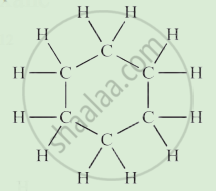 |
Give an example for each of the following statement.
A compound in which three covalent bonds are formed.
Acetic acid was added to a solid X kept in a test tube. A colourless, odourless gas Y was evolved. The gas was passed through lime water, which turned milky. It was concluded that ______.
