Advertisements
Advertisements
Question
Draw the electron-dot structure of NH3 and state the type of bonding.
Advertisements
Solution
The electron-dot structure of NH3 is:

In NH3, each hydrogen atom shares its one electron with the nitrogen atom to form a covalent bond.
APPEARS IN
RELATED QUESTIONS
Fill in the blank in the following sentence:
In forming N2 molecule, .............. electrons are shared by each atom of nitrogen.
What type of chemical bond is present in chlorine molecule? Explain your answer.
Draw the electron-dot structure of a hydrogen chloride molecule.
Draw the electron-dot structure of HCl compound and state the type of bonding.
Why are covalent compounds generally poor conductors of electricity?
Buckminsterfullerene is an allotropic form of the element:
(a) phoshorus
(b) fluorine
(c) carbon
(d) sulphur
Give the characteristic properties of covalent compounds.
State the type of bonding in the following molecule.
Methane
Give two example in following case:
Gaseous polar compounds
Draw an electron dot structure of the following molecule. (Without showing the circle) :
Water
Fill in the blank with correct word from the bracket.
Melting and boiling points of covalent compounds are generally ______ (low, high).
What do you understand by dipole (polar) molecule?
Element A has 2 electrons in its M shell. Element B has atomic number 7.
If the compound formed between A and B is melted and an electric current is passed through the molten compound, the element A will be obtained at the ______ and B at the ______ of the electrolytic cell.
In the formation of electrovalent compounds, electrons are transferred from one element to another. How are electrons involved in the formation of a covalent compound?
Complete the following activity.
Write the names of the hydrocarbons for the following structural formula.
(isobutylene, cyclohexane, propene, cyclohexene, cyclopentane, benzene, propyne, isobutane, propane)
| \[\begin{array}{cc} \phantom{..}\ce{H}\phantom{...}\ce{H}\phantom{...}\ce{H}\\ \phantom{..}|\phantom{....}|\phantom{....}|\\ \ce{H - C - C- C- H}\\ \phantom{.}|\phantom{....}|\phantom{....}|\\ \ce{H - C - H}\\ |\\\ce{H}\end{array}\] |
Complete the following activity.
Write the names of the hydrocarbons for the following structural formula.
(isobutylene, cyclohexane, propene, cyclohexene, cyclopentane, benzene, propyne, isobutane, propane)
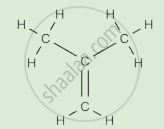 |
Complete the following activity.
Write the names of the hydrocarbons for the following structural formula.
(isobutylene, cyclohexane, propene, cyclohexene, cyclopentane, benzene, propyne, isobutane, propane)
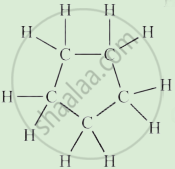 |
Two carbon atoms can always form one or two covalent bonds.
The electron dot structure of chlorine molecule is:
In covalent compounds, the bond is formed due to ______ of electrons.
