Advertisements
Advertisements
Question
The decomposition of A into product has value of k as 4.5 × 10³ s−1 at 10°C and energy of activation 60 kJ mol−1. At what temperature would k be 1.5 × 10⁴ s−1?
Advertisements
Solution
Given: k1 = 4.5 × 10³ s−1
T1 = 273 + 10 = 283 K
k2 = 1.5 × 10⁴ s−1
Ea = 60 kJ mol−1 = 6.0 × 10⁴ J mol−1
T2 = ?
From Arrhenius equation, we obtain,
`log k_2/k_1 = E_a/(2.303 R)((T_2 - T_1)/(T_1T_2))`
⇒ log `(1.5 xx 10^4)/(4.5 xx 10^3) = (60000)/(2.303 xx 8.314) ((T_2 - 283) /(283 xx T_2))`
⇒ log 3.333 = `3133.63 (T_2 - 283)/(283 xx T_2)`
⇒ 0.5228 = `3133.63 (T_2 - 283)/(283 xx T_2)`
⇒ `0.5228/3133.63 = (T_2 - 283)/(283 xx T_2)`
⇒ 1.6683 × 10−4 = `(T_2 - 283)/(283 xx T_2)`
⇒ 1.6683 × 10−4 × 283 × T2 = T2 − 283
⇒ 0.0472 T2 = T2 − 283
283 = T2 − 0.0472 T2
283 = (1 − 0.0472) T2
283 = 0.9528 T2
⇒ T2 = `283/0.9528`
= 297 K
= 297 − 273
= 24°C
Hence, k would be 1.5 × 10⁴ s−1 at 24°C.
Notes
The answer in the textbook is incorrect.
RELATED QUESTIONS
Explain a graphical method to determine activation energy of a reaction.
Consider the reaction
`3I_((aq))^-) +S_2O_8^(2-)->I_(3(aq))^-) + 2S_2O_4^(2-)`
At particular time t, `(d[SO_4^(2-)])/dt=2.2xx10^(-2)"M/s"`
What are the values of the following at the same time?
a. `-(d[I^-])/dt`
b. `-(d[S_2O_8^(2-)])/dt`
c. `-(d[I_3^-])/dt`
The rate constant of a first order reaction increases from 4 × 10⁻² to 8 × 10⁻² when the temperature changes from 27°C to 37°C. Calculate the energy of activation (Ea). (log 2 = 0.301, log 3 = 0.4771, log 4 = 0.6021)
The rate constant for the first-order decomposition of H2O2 is given by the following equation:
`logk=14.2-(1.0xx10^4)/TK`
Calculate Ea for this reaction and rate constant k if its half-life period be 200 minutes.
(Given: R = 8.314 JK–1 mol–1)
What will be the effect of temperature on rate constant?
The rate of the chemical reaction doubles for an increase of 10 K in absolute temperature from 298 K. Calculate Ea.
The activation energy for the reaction \[\ce{2 HI_{(g)} -> H2_{(g)} + I2_{(g)}}\] is 209.5 kJ mol−1 at 581 K. Calculate the fraction of molecules of reactants having energy equal to or greater than activation energy?
The rate constant for the decomposition of N2O5 at various temperatures is given below:
| T/°C | 0 | 20 | 40 | 60 | 80 |
| 105 × k/s−1 | 0.0787 | 1.70 | 25.7 | 178 | 2140 |
Draw a graph between ln k and `1/T` and calculate the values of A and Ea. Predict the rate constant at 30º and 50ºC.
The rate of a reaction quadruples when the temperature changes from 293 K to 313 K. Calculate the energy of activation of the reaction assuming that it does not change with temperature.
In the Arrhenius equation for a first order reaction, the values of ‘A’ of ‘Ea’ are 4 × 10¹³ sec−1 and 98.6 kJ mol−1 respectively. At what temperature will its half life period be 10 minutes?
[R = 8.314 J K−1 mol−1]
A first-order reaction is 50% completed in 40 minutes at 300 K and in 20 minutes at 320 K. Calculate the activation energy of the reaction. (Given : log 2 = 0·3010, log 4 = 0·6021, R = 8·314 JK–1 mol–1)
The decomposition of a hydrocarbon has value of rate constant as 2.5×10⁴s-1 At 27° what temperature would rate constant be 7.5×104 × 3 s-1if energy of activation is 19.147 × 10³ J mol-1 ?
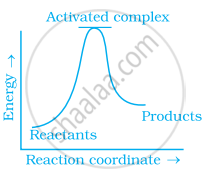
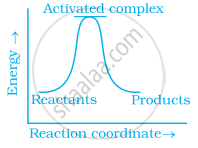
Consider figure and mark the correct option.
Which of the following graphs represents exothermic reaction?
(a)

(b)
(c)
Why does the rate of a reaction increase with rise in temperature?
The rate constant for a reaction is 1.5 × 10⁻⁷ sec–1 at 50°C. What is the value of activation energy?
The equation k = `(6.5 xx 10^12 "s"^(-1))"e"^(- 26000 " K"//"T")` is followed for the decomposition of compound A. The activation energy for the reaction is ______ kJ mol-1. (Nearest integer) (Given: R = 8.314 JK-1 mol-1)
Assertion (A): A reaction can have zero activation energy.
Reason (R): The minimum extra amount of energy absorbed by reactant molecules so that their energy becomes equal to the threshold value is called activation energy.
In the light of the above statements, choose the correct answer from the options given below:
