Advertisements
Advertisements
Question
Match the statements given in Column I and Column II
| Column I | Column I | |
| (i) | Catalyst alters the rate of reaction | (a) cannot be fraction or zero |
| (ii) | Molecularity | (b) proper orientation is not there always |
| (iii) | Second half life of first order reaction | (c) by lowering the activation energy |
| (iv) | `e^((-E_a)/(RT)` | (d) is same as the first |
| (v) | Energetically favourable reactions (e) total probability is one are sometimes slow | (e) total probability is one |
| (vi) | Area under the Maxwell Boltzman curve is constant | (f) refers to the fraction of molecules with energy equal to or greater than activation energy |
Advertisements
Solution
| Column I | Column I | |
| (i) | Catalyst alters the rate of reaction | (c) by lowering the activation energy |
| (ii) | Molecularity | (a) cannot be fraction or zero |
| (iii) | Second half life of first order reaction | (d) is same as the first |
| (iv) | `e^((-E_a)/(RT)` | (f) refers to the fraction of molecules with energy equal to or greater than activation energy |
| (v) | Energetically favourable reactions (e) total probability is one are sometimes slow | (b) proper orientation is not there always |
| (vi) | Area under the Maxwell Boltzman curve is constant | (e) total probability is one |
Explanation:
(i) Catalyst alters the rate of reaction by lowering activation energy.
(ii) Molecularity cannot be fraction or zero. If molecularity is zero, reaction is not possible.
(iii) Second half-life of first order reaction is same as first because half-life
time is temperature independent. ‘
(iv) `e^((-E_a)/(RT)` refers to the fraction of molecules with kinetic energy equal to greater than activation energy.
(v) Energetically favourble reactions are sometimes slow due to improper orientation of molecule cause some ineffective collision of molecules.
(vi) Area under the Maxwell-Boltzmann curve is constant because total probability of molecule taking part in a chemical reaction is equal to one.
APPEARS IN
RELATED QUESTIONS
Explain a graphical method to determine activation energy of a reaction.
Consider the reaction
`3I_((aq))^-) +S_2O_8^(2-)->I_(3(aq))^-) + 2S_2O_4^(2-)`
At particular time t, `(d[SO_4^(2-)])/dt=2.2xx10^(-2)"M/s"`
What are the values of the following at the same time?
a. `-(d[I^-])/dt`
b. `-(d[S_2O_8^(2-)])/dt`
c. `-(d[I_3^-])/dt`
The rate of the chemical reaction doubles for an increase of 10 K in absolute temperature from 298 K. Calculate Ea.
The activation energy for the reaction \[\ce{2 HI_{(g)} -> H2_{(g)} + I2_{(g)}}\] is 209.5 kJ mol−1 at 581 K. Calculate the fraction of molecules of reactants having energy equal to or greater than activation energy?
Define activation energy.
What is the effect of adding a catalyst on Activation energy (Ea)
The decomposition of a hydrocarbon has value of rate constant as 2.5×10⁴s-1 At 27° what temperature would rate constant be 7.5×104 × 3 s-1if energy of activation is 19.147 × 10³ J mol-1 ?
Write a condition under which a bimolecular reaction is kinetically first order. Give an example of such a reaction. (Given : log2 = 0.3010,log 3 = 0.4771, log5 = 0.6990).
Predict the main product of the following reactions: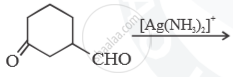
The chemical reaction in which reactants require high amount of activation energy are generally ____________.
The rate of chemical reaction becomes double for every 10° rise in temperature because of ____________.
Mark the incorrect statements:
(i) Catalyst provides an alternative pathway to reaction mechanism.
(ii) Catalyst raises the activation energy.
(iii) Catalyst lowers the activation energy.
(iv) Catalyst alters enthalpy change of the reaction.
Oxygen is available in plenty in air yet fuels do not burn by themselves at room temperature. Explain.
The activation energy in a chemical reaction is defined as ______.
The activation energy in a chemical reaction is defined as ______.
The slope of Arrhenius Plot `("In" "k" "v"//"s" 1/"T")` of first-order reaction is −5 × 10³ K. The value of Ea of the reaction is. Choose the correct option for your answer. [Given R = 8.314 JK−1mol−1]
The activation energy of one of the reactions in a biochemical process is 532611 J mol–1. When the temperature falls from 310 K to 300 K, the change in rate constant observed is k300 = x × 10–3 k310. The value of x is ______.
[Given: ln 10 = 2.3, R = 8.3 J K–1 mol–1]
Which plot of ln k vs `1/T` is consistent with the Arrhenius equation?
Activation energy of any chemical reactions can be calculated if one knows the value of:
