Advertisements
Advertisements
Question
Match the graph given in Column I with the order of reaction given in Column II. More than one item in Column I may link to the same item of Column II.
| Column I | Column II | |
| (i) | 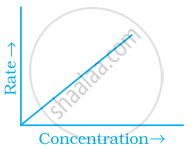 |
|
| (ii) | 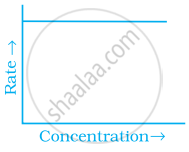 |
(a) 1st order |
| (iii) | 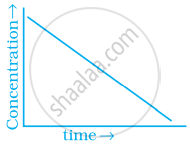 |
(b) Zero-order |
| (iv) | 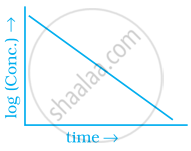 |
Advertisements
Solution
| Column I | Column II | |
| (i) | |
(a) 1st order |
| (ii) | |
(b) Zero-order |
| (iii) | |
(b) Zero order |
| (iv) | |
(a) 1st order |
Explanation:
For zero order reaction rate equation may be written as [R] = – kt + [R0]
Which denotes a straight line equation similar to y = mx + c
On transmitting (i) `([R] - [R_0])/t = - k`
`k = ([R_0] - [R])/t`
k = Rate
Rate = `k.[t]^0`
Rate `oo [t]^0`
For a first order reaction `(dx)/(dt) oo` [concentration]
∴ Graph between rate and concentration may be drawn as
`k = 2.303/t log ([R]_0)/([R])`
`(kt)/2.303 = log ([R]_0)/([R])`
`(kt)/2.303 = log[R_0] - log[R]`
\[\ce{log[R] = \underset{(Slope)}{\frac{-k}{2.303}} t + \underset{(Intercept)}{log[R]_0}}\]
APPEARS IN
RELATED QUESTIONS
A reaction is second order in A and first order in B.
(i) Write the differential rate equation.
(ii) How is the rate affected on increasing the concentration of A three times?
(iii) How is the rate affected when the concentrations of both A and B are doubled?
Write molecularity of the following reaction:
2NO(g)+O2(g)→2NO2(g)
For a reaction : 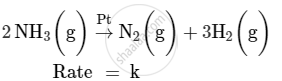
(i) Write the order and molecularity of this reaction.
(ii) Write the unit of k.
From the rate expression for the following reaction, determine the order of reaction and the dimension of the rate constant.
\[\ce{3NO_{(g)} -> N2O_{(g)}}\] Rate = k[NO]2
From the rate expression for the following reaction, determine the order of reaction and the dimension of the rate constant.
\[\ce{CH3CHO_{(g)} -> CH4_{(g)} + CO_{(g)}}\] Rate = k[CH3CHO]3/2
A reaction is first order in A and second order in B. Write the differential rate equation.
A reaction is first order in A and second order in B. How is the rate affected when the concentrations of both A and B are doubled?
Write the principle behind the following methods of refining:
Hydraulic washing
Define the following term:
Pseudo first-order reaction
Assertion: Order of the reaction can be zero or fractional.
Reason: We cannot determine order from balanced chemical equation.
Assertion: Order and molecularity are same.
Reason: Order is determined experimentally and molecularity is the sum of the stoichiometric coefficient of rate determining elementary step.
Assertion: The enthalpy of reaction remains constant in the presence of a catalyst.
Reason: A catalyst participating in the reaction, forms different activated complex and lowers down the activation energy but the difference in energy of reactant and product remains the same.
Use Molecular Orbital theory to determine the bond order in each of species, [He2j+ and [He2]2+?
For a reaction R → p the concentration of reactant change from 0.03 m to 0.02 m in minute, calculate the average rate of the reaction using the unit of second.
At concentration of 0.1 and 0.2 mol L–1 the rates of deem position of a compound were found to be 0.18 and 0.72 mol L–1 m–1. What is the order of the reaction?
Identify the order of reaction from the following unit for its rate constant:
L mol–1 s–1
The following data was obtained for chemical reaction given below at 975 K.
\[\ce{2NO(g) + 2H2(g) -> N2(g) + 2H2O(g)}\]
| [NO] | [H2] | Rate | |
| Mol L-1 | Mol L-1 | Mol L-1 s-1 | |
| (1) | 8 × 10⁻⁵ | 8 × 10⁻⁵ | 7 × 10⁻⁹ |
| (2) | 24 × 10-5 | 8 × 10⁻⁵ | 2.1 × 10⁻⁸ |
| (3) | 24 × 10-5 | 32 × 10-5 | 8.4 × 10⁻⁸ |
The order of the reaction with respect to NO is ______. (Integer answer)
Which of the following statement is true?
