Advertisements
Advertisements
Question
Why can we not determine the order of a reaction by taking into consideration the balanced chemical equation?
Advertisements
Solution
Balanced chemical equation often leads to incorrect order or rate law. For example the following reaction seems to be a tenth order reaction.
\[\ce{KClO3 + 6FeSO4 + 3H2SO4 -> KCl + 3H2O + 3Fe2 (SO4)3}\]
This is actually a second order reaction. Actually the reaction is complex and occurs in several steps. The order of such reaction is determined by the slowest step in the reaction mechanism. Order is determined experimentally and is confined to the dependence of observed rate of reaction on the concentration of reactants.
APPEARS IN
RELATED QUESTIONS
A → B is a first order reaction with rate 6.6 × 10⁻⁵m-s-1. When [A] is 0.6m, rate constant of the reaction is
- 1.1 × 10⁻⁵s-1
- 1.1 × 10⁻⁴s-1
- 9 × 10⁻⁵s-1
- 9 × 10⁻⁴s-1
Write molecularity of the following reaction:
2NO(g)+O2(g)→2NO2(g)
For the hydrolysis of methyl acetate in aqueous solution, the following results were obtained :
| t/s | 0 | 30 | 60 |
| [CH3COOCH3] / mol L–1 | 0.60 | 0.30 | 0.15 |
(i) Show that it follows pseudo first order reaction, as the concentration of water remains constant.
(ii) Calculate the average rate of reaction between the time interval 30 to 60 seconds.
(Given log 2 = 0.3010, log 4 = 0.6021)
For a reaction R ---> P, half-life (t1/2) is observed to be independent of the initial concentration of reactants. What is the order of reaction?
The decomposition of N2O5(g) at 320K according to the following equation follows first order reaction:
`N_2O_(5(g))->2NO_(2(g))+1/2O_(2(g))`
The initial concentration of N2O5(g) is 1.24 x 10⁻² mol. L-1 and after 60 minutes 0.20x10⁻² molL-1. Calculate the rate constant of the reaction at 320K.
The value of rate constant of a pseudo first order reaction ______.
For which type of reactions, order and molecularity have the same value?
In a reaction if the concentration of reactant A is tripled, the rate of reaction becomes twenty seven times. What is the order of the reaction?
Match the graph given in Column I with the order of reaction given in Column II. More than one item in Column I may link to the same item of Column II.
| Column I | Column II | |
| (i) | 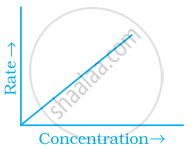 |
|
| (ii) | 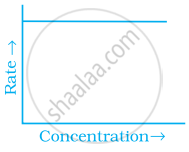 |
(a) 1st order |
| (iii) | 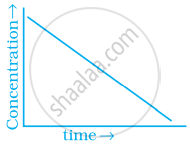 |
(b) Zero-order |
| (iv) | 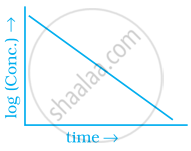 |
Assertion: Order of the reaction can be zero or fractional.
Reason: We cannot determine order from balanced chemical equation.
Use Molecular Orbital theory to determine the bond order in each of species, [He2j+ and [He2]2+?
A catalyst in a reaction changes which of the following?
In the presence of a catalyst, the heat evolved or absorbed during the reaction.
For a reaction A + B → products, the rate law is given by: r = `K[A]^(1/2)`. What is the order of reaction?
The rate of a chemical reaction double for every 10° rise in temperature. If the temperature is raised. by 50°C, the rate of relation by about:-
On heating compound (A) gives a gas (B) which is constituent of air. The gas when treated with H2 in the presence of catalyst gives another gas (C) which is basic in nature, (A) should not be ______.
The following data was obtained for chemical reaction given below at 975 K.
\[\ce{2NO(g) + 2H2(g) -> N2(g) + 2H2O(g)}\]
| [NO] | [H2] | Rate | |
| Mol L-1 | Mol L-1 | Mol L-1 s-1 | |
| (1) | 8 × 10⁻⁵ | 8 × 10⁻⁵ | 7 × 10⁻⁹ |
| (2) | 24 × 10-5 | 8 × 10⁻⁵ | 2.1 × 10⁻⁸ |
| (3) | 24 × 10-5 | 32 × 10-5 | 8.4 × 10⁻⁸ |
The order of the reaction with respect to NO is ______. (Integer answer)
A reaction is second order with respect to a reactant. How is the rate of reaction affected if the concentration of the reactant is reduced to half?
Higher yield of NO in \[\ce{N2(g) + O2 <=> 2NO(g)}\] can be obtained at:
[ΔH of the reaction = +180.7 kJ mol−1]
- higher temperature
- lower temperature
- higher concentration of N2
- higher concentration of O2
Choose the correct answer from the options given below:
