Advertisements
Advertisements
Question
For the reaction:
\[\ce{2A + B -> A2B}\]
the rate = k[A][B]2 with k = 2.0 × 10⁻⁶ mol−2 L2 s−1. Calculate the initial rate of the reaction when [A] = 0.1 mol L−1, [B] = 0.2 mol L−1. Calculate the rate of reaction after [A] is reduced to 0.06 mol L−1.
Advertisements
Solution
Given: [A] = 0.1 mol L−1
[B] = 0.2 mol L−1
k = 2.0 × 10⁻⁶
The initial rate of the reaction is
Rate = k[A][B]2
= 2.0 × 10−6 × 0.1 × (0.2)2
= 8 × 10⁻⁹ mol L−1 s−1
When [A] reduces to 0.06 mol L−1, i.e. 0.04 mol L−1 of A has reacted, then the reactant B
= `1/2 xx 0.04`
= 0.02 mol L−1
Hence, the new [B] = 0.2 − 0.02 = 0.18 mol L−1
Thus, the new concentrations of A and B are
[A] = 0.06 mol L−1,
[B] = 0.18 mol L−1,
Now rate = 2.0 × 10−6 × (0.06) × (0.18)2
= 3.89 × 10⁻⁹ mol L−1 s−1
APPEARS IN
RELATED QUESTIONS
What is pseudo first order reaction? Give one· example of it.
For a reaction: 
Rate = k
(i) Write the order and molecularity of this reaction.
(ii) Write the unit of k.
For a reaction A + B ⟶ P, the rate is given by
Rate = k [A] [B]2
What is the overall order of reaction if A is present in large excess?
From the rate expression for the following reaction, determine the order of reaction and the dimension of the rate constant.
\[\ce{3NO_{(g)} -> N2O_{(g)}}\] Rate = k[NO]2
A reaction is first order in A and second order in B. How is the rate affected when the concentrations of both A and B are doubled?
Define the following term:
Pseudo first-order reaction
Which of the following statement is true for order of a reaction?
For a complex reaction:
(i) order of overall reaction is same as molecularity of the slowest step.
(ii) order of overall reaction is less than the molecularity of the slowest step.
(iii) order of overall reaction is greater than molecularity of the slowest step.
(iv) molecularity of the slowest step is never zero or non interger.
For which type of reactions, order and molecularity have the same value?
For a general reaction A → B, plot of concentration of A vs time is given in figure. Answer the following question on the basis of this graph.
(i) What is the order of the reaction?
(ii) What is the slope of the curve?
(iii) What are the units of rate constant?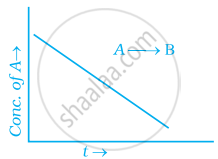
Why can we not determine the order of a reaction by taking into consideration the balanced chemical equation?
Use Molecular Orbital theory to determine the bond order in each of species, [He2j+ and [He2]2+?
A catalyst in a reaction changes which of the following?
The role of a catalyst is to change
For a first order A → B, the reaction rate at reactant concentration of 0.01 m is found to be 2.0 × 10⁻⁵. The half-life period of reaction.
If the 0.05 molar solution of m+ is replaced by a 0.0025 molar m+ solution, then the magnitude of the cell potential would be
For the reaction, \[\ce{A +2B → AB2}\], the order w.r.t. reactant A is 2 and w.r.t. reactant B. What will be change in rate of reaction if the concentration of A is doubled and B is halved?
For a chemical reaction starting with some initial concentration of reactant At as a function of time (t) is given by the equation,
`1/("A"_"t"^4) = 2 + 1.5 xx 10^-3` t
The rate of disappearance of [A] is ____ × 10-2 M/sec when [A] = 2 M.
[Given: [At] in M and t in sec.]
[Express your answer in terms of 10-2 M /s]
[Round off your answer if required]
Higher yield of NO in \[\ce{N2(g) + O2 <=> 2NO(g)}\] can be obtained at:
[ΔH of the reaction = +180.7 kJ mol−1]
- higher temperature
- lower temperature
- higher concentration of N2
- higher concentration of O2
Choose the correct answer from the options given below:
