Advertisements
Advertisements
प्रश्न
For the reaction:
\[\ce{2A + B -> A2B}\]
the rate = k[A][B]2 with k = 2.0 × 10⁻⁶ mol−2 L2 s−1. Calculate the initial rate of the reaction when [A] = 0.1 mol L−1, [B] = 0.2 mol L−1. Calculate the rate of reaction after [A] is reduced to 0.06 mol L−1.
Advertisements
उत्तर
Given: [A] = 0.1 mol L−1
[B] = 0.2 mol L−1
k = 2.0 × 10⁻⁶
The initial rate of the reaction is
Rate = k[A][B]2
= 2.0 × 10−6 × 0.1 × (0.2)2
= 8 × 10⁻⁹ mol L−1 s−1
When [A] reduces to 0.06 mol L−1, i.e. 0.04 mol L−1 of A has reacted, then the reactant B
= `1/2 xx 0.04`
= 0.02 mol L−1
Hence, the new [B] = 0.2 − 0.02 = 0.18 mol L−1
Thus, the new concentrations of A and B are
[A] = 0.06 mol L−1,
[B] = 0.18 mol L−1,
Now rate = 2.0 × 10−6 × (0.06) × (0.18)2
= 3.89 × 10⁻⁹ mol L−1 s−1
APPEARS IN
संबंधित प्रश्न
Define “zero order reaction”.
Write molecularity of the following reaction:
2NO(g)+O2(g)→2NO2(g)
For a reaction : 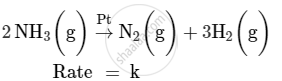
(i) Write the order and molecularity of this reaction.
(ii) Write the unit of k.
For a chemical reaction R → P, the variation in the concentration (R) vs. time (t) plot is given as:
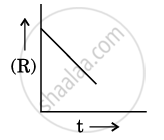
(i) Predict the order of the reaction.
(ii) What is the slope of the curve?
(iii) Write the unit of rate constant for this reaction.
The following data were obtained during the first order thermal decomposition of SO2Cl2 at a constant volume :
SO2Cl2 (g) → SO2 (g) + Cl2 (g)
| Experiment | Time/s–1 | Total pressure/atm |
| 1 | 0 | 0.4 |
| 2 | 100 | 0.7 |
Calculate the rate constant.
(Given : log 4 = 0.6021, log 2 = 0.3010)
A reaction is second order with respect to a reactant. How is the rate of reaction affected if the concentration of the reactant is doubled?
A reaction is first order in A and second order in B. Write the differential rate equation.
In a reaction between A and B, the initial rate of reaction (r0) was measured for different initial concentrations of A and B as given below:
| A/mol L−1 | 0.20 | 0.20 | 0.40 |
| B/mol L−1 | 0.30 | 0.10 | 0.05 |
| r0/mol L−1 s−1 | 5.07 × 10⁻⁵ | 5.07 × 10⁻⁵ | 1.43 × 10⁻⁴ |
What is the order of the reaction with respect to A and B?
Write resonating structures of ozone.
Molecularity of a reaction _____________.
Match the graph given in Column I with the order of reaction given in Column II. More than one item in Column I may link to the same item of Column II.
| Column I | Column II | |
| (i) | 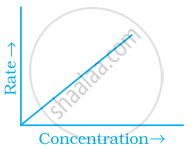 |
|
| (ii) | 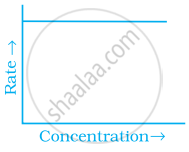 |
(a) 1st order |
| (iii) | 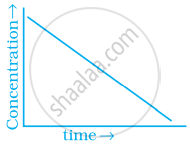 |
(b) Zero-order |
| (iv) | 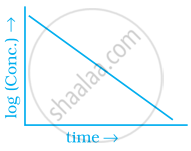 |
A catalyst in a reaction changes which of the following?
If the 0.05 molar solution of m+ is replaced by a 0.0025 molar m+ solution, then the magnitude of the cell potential would be
The half-life period of a. substance in a certain enzyme catalysed reaction is 138 s. The time required for the concentration of the substance to fall from 1.28 mol–1 to 0.04 mg L–1 is
On heating compound (A) gives a gas (B) which is constituent of air. The gas when treated with H2 in the presence of catalyst gives another gas (C) which is basic in nature, (A) should not be ______.
A flask contains a mixture of compounds A and B. Both compounds decompose by first-order kinetics. The half-lives for A and B are 300 s and 180 s, respectively. If the concentrations of A and B are equal initially, the time required for the concentration of A to be four times that of B (in s) is ______. (Use ln 2 = 0.693)
