Advertisements
Advertisements
प्रश्न
Assertion: Order of the reaction can be zero or fractional.
Reason: We cannot determine order from balanced chemical equation.
विकल्प
Both assertion and reason are correct and the reason is correct explanation of assertion.
Both assertion and reason are correct but reason does not explain assertion.
Assertion is correct but reason is incorrect.
Both assertion and reason are incorrect.
Assertion is incorrect but reason is correct.
Advertisements
उत्तर
Both assertion and reason are correct but reason does not explain assertion.
Explanation:
Order of a reaction may be zero or fractional. Order can be determined by rate law expression.
APPEARS IN
संबंधित प्रश्न
Define “zero order reaction”.
A reaction is second order in A and first order in B.
(i) Write the differential rate equation.
(ii) How is the rate affected on increasing the concentration of A three times?
(iii) How is the rate affected when the concentrations of both A and B are doubled?
Write molecularity of the following reaction:
2NO(g)+O2(g)→2NO2(g)
For a chemical reaction R → P, the variation in the concentration (R) vs. time (t) plot is given as:
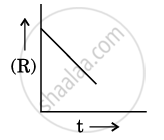
(i) Predict the order of the reaction.
(ii) What is the slope of the curve?
(iii) Write the unit of rate constant for this reaction.
The following data were obtained during the first order thermal decomposition of SO2Cl2 at a constant volume :
SO2Cl2 (g) → SO2 (g) + Cl2 (g)
| Experiment | Time/s–1 | Total pressure/atm |
| 1 | 0 | 0.4 |
| 2 | 100 | 0.7 |
Calculate the rate constant.
(Given : log 4 = 0.6021, log 2 = 0.3010)
For the reaction:
\[\ce{2A + B -> A2B}\]
the rate = k[A][B]2 with k = 2.0 × 10⁻⁶ mol−2 L2 s−1. Calculate the initial rate of the reaction when [A] = 0.1 mol L−1, [B] = 0.2 mol L−1. Calculate the rate of reaction after [A] is reduced to 0.06 mol L−1.
The decomposition of N2O5(g) at 320K according to the following equation follows first order reaction:
`N_2O_(5(g))->2NO_(2(g))+1/2O_(2(g))`
The initial concentration of N2O5(g) is 1.24 x 10⁻² mol. L-1 and after 60 minutes 0.20x10⁻² molL-1. Calculate the rate constant of the reaction at 320K.
Write the principle behind the following methods of refining:
Hydraulic washing
Define the following term:
Pseudo first-order reaction
Rate of reaction for the combustion of propane is equal to:
\[\ce{C3H8_{(g)} + 5O2_{(g)} -> 3CO2_{(g)} + 4H2O_{(g)}}\]
Which of the following statement is true for order of a reaction?
Why does the rate of any reaction generally decreases during the course of the reaction?
Why molecularity is applicable only for elementary reactions and order is applicable for elementary as well as complex reactions?
Assertion: The enthalpy of reaction remains constant in the presence of a catalyst.
Reason: A catalyst participating in the reaction, forms different activated complex and lowers down the activation energy but the difference in energy of reactant and product remains the same.
For a reaction A + B → products, the rate law is given by: r = `K[A]^(1/2)`. What is the order of reaction?
For a reaction R → p the concentration of reactant change from 0.03 m to 0.02 m in minute, calculate the average rate of the reaction using the unit of second.
For a reaction \[\ce{Cl2l(g) + 2No(g) -> 2NaCl(g)}\] the rate law is expressed as rate= K[Cl2] [No]2 what is the order of the reaction?
A reaction is second order with respect to a reactant. How is the rate of reaction affected if the concentration of the reactant is reduced to half?
