Advertisements
Advertisements
प्रश्न
For the first order thermal decomposition reaction, the following data were obtained:

Time / sec Totalpressure / atm
0 0.30
300 0.50
Calculate the rate constant
(Given: log 2 = 0.301, log3 = 0.4771, log 4 = 0.6021)
Advertisements
उत्तर
Given :
Pi = 0.30 atm
Pt = 0.50 atm
C2H5Cl(g)→C2H4(g)+HCl(g)
Pi 0 0 (At t = 0 sec)
Pi-x x x (At t = 300 sec)
So,
Pi - x + x + x = Pt
0.3+x = 0.5
x = 0.2
Then, Pi - x = 0.3 - 0.2 = 0.1 atm
For first order reaction,
`k=2.303/tlog(P_i/(P_i-x))`
`=2.303/tlog(0.3/0.1)`
`=(2.303xxlog3)/300=(2.303xx0.4771)/300`
k = 0.0037 s-1
APPEARS IN
संबंधित प्रश्न
For a chemical reaction R → P, the variation in the concentration (R) vs. time (t) plot is given as:
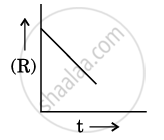
(i) Predict the order of the reaction.
(ii) What is the slope of the curve?
(iii) Write the unit of rate constant for this reaction.
The decomposition of N2O5(g) at 320K according to the following equation follows first order reaction:
`N_2O_(5(g))->2NO_(2(g))+1/2O_(2(g))`
The initial concentration of N2O5(g) is 1.24 x 10⁻² mol. L-1 and after 60 minutes 0.20x10⁻² molL-1. Calculate the rate constant of the reaction at 320K.
Which of the following statement is true for order of a reaction?
For which type of reactions, order and molecularity have the same value?
Why is the probability of reaction with molecularity higher than three very rare?
Why can’t molecularity of any reaction be equal to zero?
Assertion: The enthalpy of reaction remains constant in the presence of a catalyst.
Reason: A catalyst participating in the reaction, forms different activated complex and lowers down the activation energy but the difference in energy of reactant and product remains the same.
For a reaction R → p the concentration of reactant change from 0.03 m to 0.02 m in minute, calculate the average rate of the reaction using the unit of second.
The rate of a chemical reaction double for every 10° rise in temperature. If the temperature is raised. by 50°C, the rate of relation by about:-
If the 0.05 molar solution of m+ is replaced by a 0.0025 molar m+ solution, then the magnitude of the cell potential would be
