Advertisements
Advertisements
प्रश्न
How does calcination differ from roasting?
Advertisements
उत्तर
| Roasting | Calcination |
| Ore is heated in excess of air. | Ore is heated in the absence or limited supply of air. |
| This is used for sulphide ores. | This is used for carbonate ores. |
| SO2 is produced along with metal oxide. | CO2 is produced along with metal oxide. |
| e.g. \[\ce{ 2ZnS + 3O2 ->[\Delta] 2ZnO + 2SO2}\] | e.g. \[\ce{ZnCO3 ->[\Delta] ZnO + CO2}\] |
APPEARS IN
संबंधित प्रश्न
In a first order reaction x → y, 40% of the given sample of compound remains unreacted in 45 minutes. Calculate rate constant of the reaction.
A → B is a first order reaction with rate 6.6 × 10⁻⁵m-s-1. When [A] is 0.6m, rate constant of the reaction is
- 1.1 × 10⁻⁵s-1
- 1.1 × 10⁻⁴s-1
- 9 × 10⁻⁵s-1
- 9 × 10⁻⁴s-1
A reaction is second order in A and first order in B.
(i) Write the differential rate equation.
(ii) How is the rate affected on increasing the concentration of A three times?
(iii) How is the rate affected when the concentrations of both A and B are doubled?
For the first order thermal decomposition reaction, the following data were obtained:

Time / sec Totalpressure / atm
0 0.30
300 0.50
Calculate the rate constant
(Given: log 2 = 0.301, log3 = 0.4771, log 4 = 0.6021)
For a reaction A + B ⟶ P, the rate is given by
Rate = k [A] [B]2
How is the rate of reaction affected if the concentration of B is doubled?
For the reaction:
\[\ce{2A + B -> A2B}\]
the rate = k[A][B]2 with k = 2.0 × 10⁻⁶ mol−2 L2 s−1. Calculate the initial rate of the reaction when [A] = 0.1 mol L−1, [B] = 0.2 mol L−1. Calculate the rate of reaction after [A] is reduced to 0.06 mol L−1.
For a reaction R ---> P, half-life (t1/2) is observed to be independent of the initial concentration of reactants. What is the order of reaction?
Write resonating structures of ozone.
Write the principle behind the following methods of refining:
Hydraulic washing
Rate of reaction for the combustion of propane is equal to:
\[\ce{C3H8_{(g)} + 5O2_{(g)} -> 3CO2_{(g)} + 4H2O_{(g)}}\]
Consider a first order gas phase decomposition reaction given below :
\[\ce{A(g) -> B(g) + C(g)}\]
The initial pressure of the system before decomposition of A was pi. After lapse of time ‘t’, total pressure of the system increased by x units and became ‘pt’ The rate constant k for the reaction is given as ______.
Which of the following statements is not correct about order of a reaction.
Rate law for the reaction \[\ce{A + 2B -> C}\] is found to be Rate = k [A][B]. Concentration of reactant ‘B’ is doubled, keeping the concentration of ‘A’ constant, the value of rate constant will be ______.
For which type of reactions, order and molecularity have the same value?
Why is the probability of reaction with molecularity higher than three very rare?
Why can we not determine the order of a reaction by taking into consideration the balanced chemical equation?
Match the graph given in Column I with the order of reaction given in Column II. More than one item in Column I may link to the same item of Column II.
| Column I | Column II | |
| (i) | 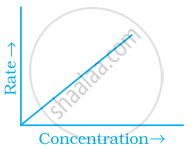 |
|
| (ii) | 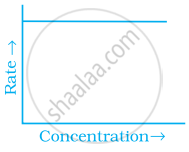 |
(a) 1st order |
| (iii) | 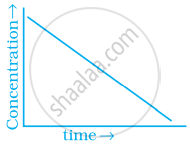 |
(b) Zero-order |
| (iv) | 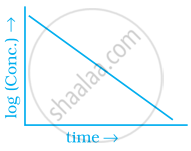 |
Assertion: Order of the reaction can be zero or fractional.
Reason: We cannot determine order from balanced chemical equation.
Use Molecular Orbital theory to determine the bond order in each of species, [He2j+ and [He2]2+?
The role of a catalyst is to change
For a reaction A + B → products, the rate law is given by: r = `K[A]^(1/2)`. What is the order of reaction?
For a reaction 1/2 A ⇒ 2B, rate of disappearance of A is related 't o the appearance of B by the expression:
For reaction 2A + B → BC + D which of the following does not Express the reaction rates
The conversion of molecules A to B follow second order kinetics. If concentration of A is increased to three times, how will it affect the rate of formation of B?
On heating compound (A) gives a gas (B) which is constituent of air. The gas when treated with H2 in the presence of catalyst gives another gas (C) which is basic in nature, (A) should not be ______.
A flask contains a mixture of compounds A and B. Both compounds decompose by first-order kinetics. The half-lives for A and B are 300 s and 180 s, respectively. If the concentrations of A and B are equal initially, the time required for the concentration of A to be four times that of B (in s) is ______. (Use ln 2 = 0.693)
Which of the following statement is true?
