Advertisements
Advertisements
प्रश्न
Derive a relation between ΔH and ΔU for a chemical reaction. Draw neat labelled diagram of calomel electrode. Resistance and conductivity of a cell containing 0.001 M KCI solution at 298K are 1500Ω and 1.46x10⁻⁴ S.cm-1 respectively.
Advertisements
उत्तर
Relation between ΔH and ΔU
The heat of reaction is given by enthalpy change
ΔH=H2 - H1
by defination H= U+PV
H1=U1+P1V1
H2=U2+P2V2
ΔH = (U1+P1V1) - (U2+P2V2)
=(U2-U1)+(P2V2-P1V1)
=ΔU+(P2V2-P1V1)(∵ΔU=U2-U1)
since PV=nRT
for initial state P1V1=n1RT
for final state P2V2=n2RT
P2V2-P1V1=n2RT-n1RT
=(n2-n)RT
=ΔnRT
where Δn = number of moles of gaseous product - number of moles of gaseous reactant.
| ΔH=ΔU+ΔnRT |
Diagram : Standard calomel electrode
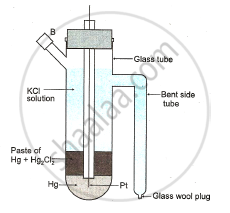
Data: R 1500Ω
C=0.001M
k= 1.46x10⁻⁴Scm-1
To find: b = ?
Solution : `k=b/R`
b=kxR
=1.46x10-4x1500
b=2190x10-4 cm-1
| b = 0.219cm-1 |
APPEARS IN
संबंधित प्रश्न
What happens if external potential applied becomes greater than E°cell of electrochemical cell?
Can you store copper sulphate solutions in a zinc pot?
Construct a labelled diagram for the following cell:
`Zn|Zn^(2+)(1M)||H^+(1M)|H_(2(g,1atm))|Pt`
Write cathode and anode reaction in a fuel cell.
Among Zn and Cu, which would occur more readily in nature as metal and which as an ion?
Define the following term:
Fuel cell
E°cell for the given redox reaction is 2.71 V
Mg(s) + Cu2+ (0.01 M) → Mg2+ (0.001 M) + Cu(s)
Calculate Ecell for the reaction. Write the direction of flow of current when an external opposite potential applied is
(i) less than 2.71 V and
(ii) greater than 2.71 V
If 'I' stands for the distance between the electrodes and 'a' stands for the area of cross-section of the electrode, `"l"/"a"` refers to ____________.
If one mole electrons is passed through the solutions of CrCl3, AgNO3 and NiSO4, in what ratio Cr, Ag and Ni will be deposited at the electrodes?
How many faradays of electricity are required for the following reaction to occur
\[\ce{MnO^-_4 -> Mn^2+}\]
A certain current liberated 0.504 gm of hydrogen in 2 hours. How many grams of copper can be liberated by the same current flowing for the same time through copper sulphate solution.
A gas X at 1 atm is bubbled through a solution containing a mixture of 1 MY− and 1 MZ− at 25°C. If the reduction potential of Z > Y > X, then ______.
Define cathode
Describe the electrolysis of molten NaCl using inert electrodes.
Why is anode in galvanic cell considered to be negative and cathode positive electrode?
Is it possible to store copper sulphate in an iron vessel for a long time?
Given: \[\ce{E^0_{{Cu^{2+}|{Cu}}}}\] = 0.34 V and \[\ce{E^0_{{Fe^{2+}|{Fe}}}}\] = −0.44 V
Two metals M1 and M2 have reduction potential values of −xV and +yV respectively. Which will liberate H2 and H2SO4.
Reduction potential of two metals M1 and M2 are \[\ce{E^0_{{M_1^{2+}|M_1}}}\] = −2.3 V and \[\ce{E^0_{{M_2^{2+}|M_2}}}\] = 0.2 V. Predict which one is better for coating the surface of iron.
Given: \[\ce{E^0_{{Fe^{2+}|Fe}}}\] = −0.44 V
A copper electrode is dipped in 0.1 M copper sulphate solution at 25°C. Calculate the electrode potential of copper.
[Given: \[\ce{E^0_{{Cu^{2+}|Cu}}}\] = 0.34 V]
Write a note on sacrificial protection.
Electrode potential for Mg electrode varies according to the equation
`E_(Mg^(2+) | Mg) = E_(Mg^(2+) | Mg)^Θ - 0.059/2 log 1/([Mg^(2+)])`. The graph of `E_(Mg^(2+) | Mg)` vs `log [Mg^(2+)]` is ______.
Which of the following statement is correct?
Which of the following statement is not correct about an inert electrode in a cell?
Use the data given in below find out the most stable ion in its reduced form.
`"E"_("Cr"_2"O"_7^(2-)//"Cr"^(3+))^⊖`= 1.33 V `"E"_("Cl"_2//"Cl"^-)^⊖` = 1.36 V
`"E"_("MnO"_4^-//"Mn"^(2+))^⊖` = 1.51 V `"E"_("Cr"^(3+)//"Cr")^⊖` = - 0.74 V
Can absolute electrode potential of an electrode be measured?
What is electrode potential?
Consider a cell given below:
\[\ce{Cu | Cu^{2+} || Cl^{-} | Cl_{2},Pt}\]
Write the reactions that occur at anode and cathode
Match the items of Column I and Column II.
| Column I | Column II |
| (i) K | (a) I × t |
| (ii) Λm | (b) `Λ_m/Λ_m^0` |
| (iii) α | (c) `K/c` |
| (iv) Q | (d) `G^∗/R` |
The electrochemical cell stops working after some time because
Calculate the standard EMF ofa cell which involves the following cell reactions
\[\ce{Zn + 2 Ag+ -> Zn^{2+} + 2 Ag}\]
Given that \[\ce{E^{o}_{Zn/Zn^{2+}}}\] = 0.76 volt and \[\ce{E^{o}_{Ag/Ag^{+}}}\] = – 0.80 volt.
Which of the following statements about galvanic cell is incorrect
A current of 2.0 ampere passed for 5 hour through a molten salt deposits 22 g of the metal (Atomic mass = 177). The oxidation state of the metal in the metal salt is
Cell reaction is spontaneous when
If the half-cell reaction A + e– → A– has a large negative reduction potential, it follow that:-
If 0.5 amp current is passed through acidified silver nitrate then in 100 minutes the mass of silver, deposite on cathode is (eq. wt. of silver nitrate + 108).
In a Daniel cell, ______.
If the value of Ksp for Hg2Cl2 (s) is X then the value of X will be ____ where pX = - log X.
Given:
\[\ce{Hg2Cl2 + 2e- -> 2Hg(l) + 2Cl-}\], E° = 0.27 V
\[\ce{Hg+2 + 2e- -> 2Hg(l)}\] E° = 0.81 V
The number of moles of electrons passed when the current of 2 A is passed through a solution of electrolyte for 20 minutes is ______.
The two half cell reaction of an electrochemical cell is given as
\[\ce{Ag+ + e- -> Ag}\], `"E"_("Ag"^+//"Ag")^circ` = - 0.3995 V
\[\ce{Fe^{2+} -> Fe^{3+} + e-}\], `"E"_("Fe"^{3+}//"Fe")^{2+}` = - 0.7120 V
The value of EMF will be ______.
Galvanic cell is a device in which ______.
What should be the signs (positive/negative) for \[\ce{E^0_{cell}}\] and ΔG0 for a spontaneous redox reaction occurring under standard conditions?
Explain why the anode is of negative polarity in a galvanic cell.
What is an electrochemical cell? What does it consist of?
Explain the types of electrochemical cells.
State the term for the following:
Two metal plates or wires through which the current enters and leaves the electrolytic cell.
