Advertisements
Advertisements
प्रश्न
For a general reaction A → B, plot of concentration of A vs time is given in figure. Answer the following question on the basis of this graph.
(i) What is the order of the reaction?
(ii) What is the slope of the curve?
(iii) What are the units of rate constant?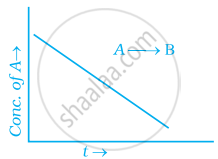
Advertisements
उत्तर
(i) Zero order reaction
(ii) [R] – [R]0 – kt
∴ Slope = – k
(iii) `(mol^-1L)/(s^-1)` = k[A]0 or k = mol–1 Ls–1
APPEARS IN
संबंधित प्रश्न
Define “zero order reaction”.
A → B is a first order reaction with rate 6.6 × 10⁻⁵m-s-1. When [A] is 0.6m, rate constant of the reaction is
- 1.1 × 10⁻⁵s-1
- 1.1 × 10⁻⁴s-1
- 9 × 10⁻⁵s-1
- 9 × 10⁻⁴s-1
Write two factors that affect the rate of reaction.
The following data were obtained during the first order thermal decomposition of SO2Cl2 at a constant volume :
SO2Cl2 (g) → SO2 (g) + Cl2 (g)
| Experiment | Time/s–1 | Total pressure/atm |
| 1 | 0 | 0.4 |
| 2 | 100 | 0.7 |
Calculate the rate constant.
(Given : log 4 = 0.6021, log 2 = 0.3010)
A reaction is first order in A and second order in B. Write the differential rate equation.
In a reaction between A and B, the initial rate of reaction (r0) was measured for different initial concentrations of A and B as given below:
| A/mol L−1 | 0.20 | 0.20 | 0.40 |
| B/mol L−1 | 0.30 | 0.10 | 0.05 |
| r0/mol L−1 s−1 | 5.07 × 10⁻⁵ | 5.07 × 10⁻⁵ | 1.43 × 10⁻⁴ |
What is the order of the reaction with respect to A and B?
For a reaction R ---> P, half-life (t1/2) is observed to be independent of the initial concentration of reactants. What is the order of reaction?
Write the principle behind the following methods of refining:
Hydraulic washing
Rate of reaction for the combustion of propane is equal to:
\[\ce{C3H8_{(g)} + 5O2_{(g)} -> 3CO2_{(g)} + 4H2O_{(g)}}\]
In any unimolecular reaction:
(i) only one reacting species is involved in the rate determining step.
(ii) the order and the molecularity of slowest step are equal to one.
(iii) the molecularity of the reaction is one and order is zero.
(iv) both molecularity and order of the reaction are one.
Why is the probability of reaction with molecularity higher than three very rare?
Why molecularity is applicable only for elementary reactions and order is applicable for elementary as well as complex reactions?
Why can we not determine the order of a reaction by taking into consideration the balanced chemical equation?
Match the graph given in Column I with the order of reaction given in Column II. More than one item in Column I may link to the same item of Column II.
| Column I | Column II | |
| (i) | 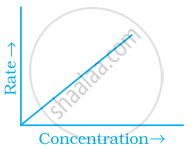 |
|
| (ii) | 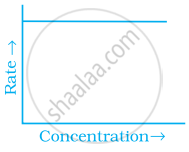 |
(a) 1st order |
| (iii) | 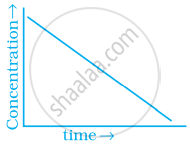 |
(b) Zero-order |
| (iv) | 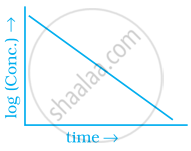 |
For a reaction \[\ce{Cl2l(g) + 2No(g) -> 2NaCl(g)}\] the rate law is expressed as rate= K[Cl2] [No]2 what is the order of the reaction?
The rate of a chemical reaction double for every 10° rise in temperature. If the temperature is raised. by 50°C, the rate of relation by about:-
At concentration of 0.1 and 0.2 mol L–1 the rates of deem position of a compound were found to be 0.18 and 0.72 mol L–1 m–1. What is the order of the reaction?
The number of molecules of the reactants taking part in a single step of the reaction is indicative of ______.
For a chemical reaction starting with some initial concentration of reactant At as a function of time (t) is given by the equation,
`1/("A"_"t"^4) = 2 + 1.5 xx 10^-3` t
The rate of disappearance of [A] is ____ × 10-2 M/sec when [A] = 2 M.
[Given: [At] in M and t in sec.]
[Express your answer in terms of 10-2 M /s]
[Round off your answer if required]
