Advertisements
Advertisements
प्रश्न
For a zero order reaction will the molecularity be equal to zero? Explain.
Advertisements
उत्तर
The molecularity of any reaction is the number of reacting species taking part in an elementary reaction. The zero molecularity means there is no reactant so the reaction does not occur. Therefore molecularity cannot be zero for a reaction.
APPEARS IN
संबंधित प्रश्न
The reaction between A and B is first order with respect to A and zero order with respect to B. Fill in the blanks in the following table:
| Experiment | A/mol L−1 | B/mol L−1 | Initial rate/mol L−1 min−1 |
| I | 0.1 | 0.1 | 2.0 × 10⁻² |
| II | ______ | 0.2 | 4.0 × 10⁻² |
| III | 0.4 | 0.4 | ______ |
| IV | ______ | 0.2 | 2.0 × 10⁻² |
Derive integrated rate law for a zero-order reaction \[\ce{A -> Product}\].
For which of the following reaction the units of rate constant and rate of the reaction are same?
At high pressure the following reaction is zero order.
\[\ce{2NH3(g) ->[1130 K][Platinum catalyst] N2(g) + 3H2(g)}\]
Which of the following options are correct for this reaction?
(i) Rate of reaction = Rate constant.
(ii) Rate of the reaction depends on concentration of ammonia.
(iii) Rate of decomposition of ammonia will remain constant until ammonia disappears completely.
(iv) Further increase in pressure will change the rate of reaction.
Which of the following graphs is correct for a zero order reaction?
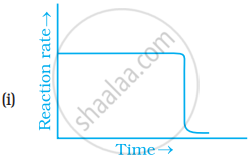

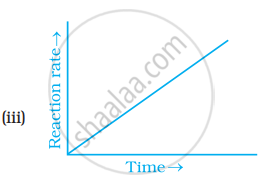

Write the rate equation for the reaction `2A + B -> C` if the order of the reaction is zero.
Derive an expression to calculate time required for completion of zero order reaction.
Consider the following statement:-
(i) Increase in concentration of reactant increases the rate of a zero-order reaction.
(ii) Rate constant k is equal to collision frequency A if Ea = 0
(iii) Rate constant k is equal to collision frequency A if Ea = 0
(iv) In k vs t is a straight line
(v) In k vs 1/T is a straight line
Which of the above statement is correct?
For a zero-order reaction, the plot of [A]t vs t is linear with a ______
Write the expression of integrated rate equation for zero order reaction.
The slope in the plot of [R] Vs. time for a zero-order reaction is ______.
The following experimental rate data were obtained for a reaction carried out at 25°C:
\[\ce{A_{(g)} + B_{(g)} -> C_{(g)} + A_{(g)}}\]
| Initial [A(g)]/mol dm−3 | Initial [B(g)]/mol dm−3 | Initial rate/mol dm−3s−1 |
| 3.0 × 10⁻² | 2.0 × 10⁻² | 1.89 × 10⁻⁴ |
| 3.0 × 10⁻² | 4.0 × 10⁻² | 1.89 × 10⁻⁴ |
| 6.0 × 10⁻² | 4.0 × 10⁻² | 7.56 × 10⁻⁴ |
What are the orders with respect to A(g) and B(g)?
Assertion (A): For a zero-order reaction, the unit of rate constant and rate of reaction are same.
Reason (R): Rate of reaction for zero order reaction is independent of concentration of reactant.
What is zeroth order reaction? Derive its integrated rate Law. What are the units of rate constant?
Derive integrated rate law for zero order reaction.
Write the unit of rate constant of zero order reaction.
What is zero order reaction?
If unit of rate constant is mol dm−3s−1, the order of reaction would be ______.
