Advertisements
Advertisements
प्रश्न
Derive an expression to calculate time required for completion of zero order reaction.
Advertisements
उत्तर
Consider a reaction,
R → Pt = 0
Here R is the reactant and P is the product.
Rate = k[R]0 t = t
`(–dR)/dt` = k , dR = – kdt .....(Instantaneous rate)
On integrating both sides,
`intDr = -k intdt`
[R] = – kt + I
At t = 0,
[R] = [R0] which makes I = R0[R] = [R0] – kt. .......(i)
Here [R] = concentration of reactant at time ‘t’.
[R0] = initial concentration of the reactant.
This reaction is known as the integrated rate equation of zero order.
After completion of zero order reaction [R] = 0
Using [R] = 0 in (i)
[R0] = kt
∴ t = `([R_0])/k`
APPEARS IN
संबंधित प्रश्न
The decomposition of NH3 on platinum surface is zero order reaction. What are the rates of production of N2 and H2 if k = 2.5 × 10⁻⁴ mol−1 L s−1?
The reaction between A and B is first order with respect to A and zero order with respect to B. Fill in the blanks in the following table:
| Experiment | A/mol L−1 | B/mol L−1 | Initial rate/mol L−1 min−1 |
| I | 0.1 | 0.1 | 2.0 × 10⁻² |
| II | ______ | 0.2 | 4.0 × 10⁻² |
| III | 0.4 | 0.4 | ______ |
| IV | ______ | 0.2 | 2.0 × 10⁻² |
The decomposition of NH3 on a platinum surface is a zero-order reaction. If the rate constant (k) is 4 x 10⁻³ ms-1, how long will it take to reduce the initial concentration of NH3 from 0.1 M to 0.064 M?
Give one example of zero order reaction.
Derive integrated rate law for a zero-order reaction \[\ce{A -> Product}\].
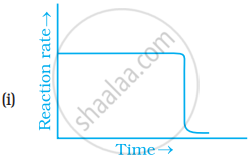
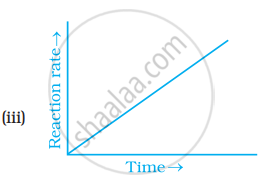
Which of the following graphs is correct for a zero order reaction?


Write the rate equation for the reaction `2A + B -> C` if the order of the reaction is zero.
A solution with initial concentration of a mol dm-3 follow zero order kinetic. The time taken for the completion of reaction is
Write the expression of integrated rate equation for zero order reaction.
If the initial concentration of substance A is 1.5 M and after 120 seconds the concentration of substance A is 0.75 M, the rate constant for the reaction if it follows zero-order kinetics is ______.
Derive integrated rate law for zero order reaction.
Write the unit of rate constant of zero order reaction.
What is zero order reaction?
If unit of rate constant is mol dm−3s−1, the order of reaction would be ______.
