Advertisements
Advertisements
प्रश्न
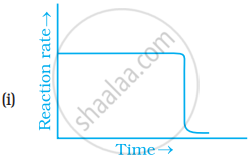
At high pressure the following reaction is zero order.
\[\ce{2NH3(g) ->[1130 K][Platinum catalyst] N2(g) + 3H2(g)}\]
Which of the following options are correct for this reaction?
(i) Rate of reaction = Rate constant.
(ii) Rate of the reaction depends on concentration of ammonia.
(iii) Rate of decomposition of ammonia will remain constant until ammonia disappears completely.
(iv) Further increase in pressure will change the rate of reaction.
Advertisements
उत्तर
(i) Rate of reaction = Rate constant.
(iii) Rate of decomposition of ammonia will remain constant until ammonia disappears completely.
(iv) Further increase in pressure will change the rate of reaction.
Explanation:
The pressure in this reaction is extremely high and it becomes independent of the ammonia concentration. The metal surface becomes saturated with gas molecules when the rate of reaction = Rate constant. The rate of a zero-order reaction is independent of the concentration of reactants in the reaction.
APPEARS IN
संबंधित प्रश्न
The decomposition of NH3 on platinum surface is zero order reaction. What are the rates of production of N2 and H2 if k = 2.5 × 10⁻⁴ mol−1 L s−1?
The reaction between A and B is first order with respect to A and zero order with respect to B. Fill in the blanks in the following table:
| Experiment | A/mol L−1 | B/mol L−1 | Initial rate/mol L−1 min−1 |
| I | 0.1 | 0.1 | 2.0 × 10⁻² |
| II | ______ | 0.2 | 4.0 × 10⁻² |
| III | 0.4 | 0.4 | ______ |
| IV | ______ | 0.2 | 2.0 × 10⁻² |
The decomposition of NH3 on a platinum surface is a zero-order reaction. If the rate constant (k) is 4 x 10⁻³ ms-1, how long will it take to reduce the initial concentration of NH3 from 0.1 M to 0.064 M?
Give one example of zero order reaction.
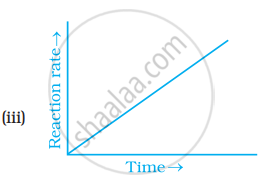
Which of the following graphs is correct for a zero order reaction?


For a zero order reaction will the molecularity be equal to zero? Explain.
Consider the following statement:-
(i) Increase in concentration of reactant increases the rate of a zero-order reaction.
(ii) Rate constant k is equal to collision frequency A if Ea = 0
(iii) Rate constant k is equal to collision frequency A if Ea = 0
(iv) In k vs t is a straight line
(v) In k vs 1/T is a straight line
Which of the above statement is correct?
For a zero-order reaction, the plot of [A]t vs t is linear with a ______
Write the expression of integrated rate equation for zero order reaction.
The following experimental rate data were obtained for a reaction carried out at 25°C:
\[\ce{A_{(g)} + B_{(g)} -> C_{(g)} + A_{(g)}}\]
| Initial [A(g)]/mol dm−3 | Initial [B(g)]/mol dm−3 | Initial rate/mol dm−3s−1 |
| 3.0 × 10⁻² | 2.0 × 10⁻² | 1.89 × 10⁻⁴ |
| 3.0 × 10⁻² | 4.0 × 10⁻² | 1.89 × 10⁻⁴ |
| 6.0 × 10⁻² | 4.0 × 10⁻² | 7.56 × 10⁻⁴ |
What are the orders with respect to A(g) and B(g)?
Assertion (A): For a zero-order reaction, the unit of rate constant and rate of reaction are same.
Reason (R): Rate of reaction for zero order reaction is independent of concentration of reactant.
What is zeroth order reaction? Derive its integrated rate Law. What are the units of rate constant?
Derive integrated rate law for zero order reaction.
Write the unit of rate constant of zero order reaction.
What is zero order reaction?
If unit of rate constant is mol dm−3s−1, the order of reaction would be ______.
