Advertisements
Advertisements
प्रश्न
For a chemical reaction R → P, the variation in the concentration (R) vs. time (t) plot is given as:
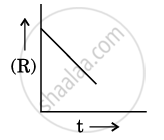
(i) Predict the order of the reaction.
(ii) What is the slope of the curve?
(iii) Write the unit of rate constant for this reaction.
Advertisements
उत्तर १
For a chemical reaction R→P, the variation in the concentration (R) vs. time (t) plot is given as follows:
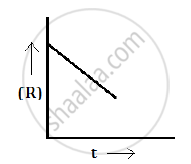
(i) The order of the reaction zero.
(ii) Slope = -k
उत्तर २
(i) Predict the order of the reaction
The graph shows a straight line when concentration of reactant R is plotted against time t.
[R] = [R]0 − kt
Since the plot is a straight line with a negative slope, the reaction is zero order.
(ii) Slope of the curve
From the zero-order equation:
[R] = [R]0 − kt
The slope of the [R] vs t graph is −k (negative of the rate constant).
(iii) Unit of rate constant
For a zero-order reaction:
Rate = k
Rate has units of concentration/time.
If concentration is in mol L−1 and time in seconds:
Unit of k = mol L−1s−1
APPEARS IN
संबंधित प्रश्न
For a reaction A + B ⟶ P, the rate is given by
Rate = k [A] [B]2
How is the rate of reaction affected if the concentration of B is doubled?
For a reaction A + B ⟶ P, the rate is given by
Rate = k [A] [B]2
What is the overall order of reaction if A is present in large excess?
The conversion of molecules X to Y follows second order kinetics. If concentration of X is increased to three times how will it affect the rate of formation of Y?
How does calcination differ from roasting?
Consider a first order gas phase decomposition reaction given below :
\[\ce{A(g) -> B(g) + C(g)}\]
The initial pressure of the system before decomposition of A was pi. After lapse of time ‘t’, total pressure of the system increased by x units and became ‘pt’ The rate constant k for the reaction is given as ______.
In any unimolecular reaction:
(i) only one reacting species is involved in the rate determining step.
(ii) the order and the molecularity of slowest step are equal to one.
(iii) the molecularity of the reaction is one and order is zero.
(iv) both molecularity and order of the reaction are one.
For a general reaction A → B, plot of concentration of A vs time is given in figure. Answer the following question on the basis of this graph.
(i) What is the order of the reaction?
(ii) What is the slope of the curve?
(iii) What are the units of rate constant?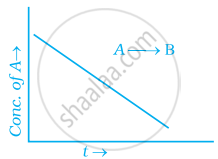
Assertion: Rate constants determined from Arrhenius equation are fairly accurate for simple as well as complex molecules.
Reason: Reactant molecules undergo chemical change irrespective of their orientation during collision.
Identify the order of reaction from the following unit for its rate constant:
L mol–1 s–1
A flask contains a mixture of compounds A and B. Both compounds decompose by first-order kinetics. The half-lives for A and B are 300 s and 180 s, respectively. If the concentrations of A and B are equal initially, the time required for the concentration of A to be four times that of B (in s) is ______. (Use ln 2 = 0.693)
