Advertisements
Advertisements
प्रश्न
For a chemical reaction R → P, the variation in the concentration (R) vs. time (t) plot is given as:
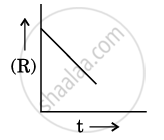
(i) Predict the order of the reaction.
(ii) What is the slope of the curve?
(iii) Write the unit of rate constant for this reaction.
Advertisements
उत्तर १
For a chemical reaction R→P, the variation in the concentration (R) vs. time (t) plot is given as follows:
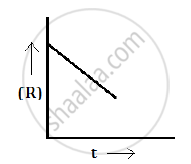
(i) The order of the reaction zero.
(ii) Slope = -k
उत्तर २
(i) Predict the order of the reaction
The graph shows a straight line when concentration of reactant R is plotted against time t.
[R] = [R]0 − kt
Since the plot is a straight line with a negative slope, the reaction is zero order.
(ii) Slope of the curve
From the zero-order equation:
[R] = [R]0 − kt
The slope of the [R] vs t graph is −k (negative of the rate constant).
(iii) Unit of rate constant
For a zero-order reaction:
Rate = k
Rate has units of concentration/time.
If concentration is in mol L−1 and time in seconds:
Unit of k = mol L−1s−1
APPEARS IN
संबंधित प्रश्न
For a reaction: 
Rate = k
(i) Write the order and molecularity of this reaction.
(ii) Write the unit of k.
Write two factors that affect the rate of reaction.
For a reaction A + B ⟶ P, the rate is given by
Rate = k [A] [B]2
What is the overall order of reaction if A is present in large excess?
From the rate expression for the following reaction, determine the order of reaction and the dimension of the rate constant.
\[\ce{C2H5Cl_{(g)} -> C2H4_{(g)} + HCl_{(g)}}\] Rate = k[C2H5Cl]
For a reaction R ---> P, half-life (t1/2) is observed to be independent of the initial concentration of reactants. What is the order of reaction?
What is the order of a reaction which has a rate expression; Rate = `"k"["A"]^(3/2)["B"]^1`?
Molecularity of a reaction _____________.
The value of rate constant of a pseudo first order reaction ______.
Assertion: Order and molecularity are same.
Reason: Order is determined experimentally and molecularity is the sum of the stoichiometric coefficient of rate determining elementary step.
On heating compound (A) gives a gas (B) which is constituent of air. The gas when treated with H2 in the presence of catalyst gives another gas (C) which is basic in nature, (A) should not be ______.
