Advertisements
Advertisements
Question
For a chemical reaction R → P, the variation in the concentration (R) vs. time (t) plot is given as:
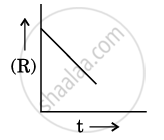
(i) Predict the order of the reaction.
(ii) What is the slope of the curve?
(iii) Write the unit of rate constant for this reaction.
Advertisements
Solution 1
For a chemical reaction R→P, the variation in the concentration (R) vs. time (t) plot is given as follows:
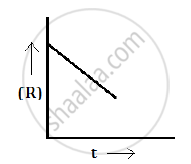
(i) The order of the reaction zero.
(ii) Slope = -k
Solution 2
(i) Predict the order of the reaction
The graph shows a straight line when concentration of reactant R is plotted against time t.
[R] = [R]0 − kt
Since the plot is a straight line with a negative slope, the reaction is zero order.
(ii) Slope of the curve
From the zero-order equation:
[R] = [R]0 − kt
The slope of the [R] vs t graph is −k (negative of the rate constant).
(iii) Unit of rate constant
For a zero-order reaction:
Rate = k
Rate has units of concentration/time.
If concentration is in mol L−1 and time in seconds:
Unit of k = mol L−1s−1
APPEARS IN
RELATED QUESTIONS
A reaction is first order in A and second order in B. How is the rate affected on increasing the concentration of B three times?
Which of the following statement is true for order of a reaction?
For which type of reactions, order and molecularity have the same value?
Why molecularity is applicable only for elementary reactions and order is applicable for elementary as well as complex reactions?
Use Molecular Orbital theory to determine the bond order in each of species, [He2j+ and [He2]2+?
In the presence of a catalyst, the heat evolved or absorbed during the reaction.
For a reaction 1/2 A ⇒ 2B, rate of disappearance of A is related 't o the appearance of B by the expression:
On heating compound (A) gives a gas (B) which is constituent of air. The gas when treated with H2 in the presence of catalyst gives another gas (C) which is basic in nature, (A) should not be ______.
The following data was obtained for chemical reaction given below at 975 K.
\[\ce{2NO(g) + 2H2(g) -> N2(g) + 2H2O(g)}\]
| [NO] | [H2] | Rate | |
| Mol L-1 | Mol L-1 | Mol L-1 s-1 | |
| (1) | 8 × 10⁻⁵ | 8 × 10⁻⁵ | 7 × 10⁻⁹ |
| (2) | 24 × 10-5 | 8 × 10⁻⁵ | 2.1 × 10⁻⁸ |
| (3) | 24 × 10-5 | 32 × 10-5 | 8.4 × 10⁻⁸ |
The order of the reaction with respect to NO is ______. (Integer answer)
Assertion (A): Order of reaction is applicable to elementary as well as complex reactions.
Reason (R): For a complex reaction, molecularity has no meaning.
