Advertisements
Advertisements
प्रश्न
Compounds ‘A’ and ‘B’ react according to the following chemical equation.
\[\ce{A(g) + 2B(g) -> 2C(g)}\]
Concentration of either ‘A’ or ‘B’ were changed keeping the concentrations of one of the reactants constant and rates were measured as a function of initial concentration. Following results were obtained. Choose the correct option for the rate equations for this reaction.
| Experiment | Initial concentration of [A]/mol L–¹ |
Initial concentration of [B]/mol L–¹ |
Initial rate of formation of [C]/mol L–¹ s–¹ |
| 1. | 0.30 | 0.30 | 0.10 |
| 2. | 0.30 | 0.60 | 0.40 |
| 3. | 0.60 | 0.30 | 0.20 |
विकल्प
Rate = k[A]2[B]
Rate = k[A][B]2
Rate = k[A][B]
Rate = k[A]2[B]0
Advertisements
उत्तर १
Rate = k[A][B]2
Explanation:
Rate = k[A]x[B]y
When concentration of B is doubled keeping the concentration of A constant, the rate of formation of C increases by a factor of four. This indicates that the rate of reactions depends upon the square of concentration of B. When concentration of A is doubled, the rate of formation of C also doubles from the initial value. This shows that the rate depends on first power of concentration of A. Hence Rate= k[A]x[B]y.
उत्तर २
Let order of A and B be x and y.
r = k [A]x [B]y
0.1 = k (0.3)x (0.3)y ...(1)
0.4 = 0.1 = k (0.3)x (0.6)y ...(2)
0.2 = 0.1 = k (0.6)x (0.3)y ...(3)
Divide 2 by 1
`0.4/0.1 = (0.6)^"y"/(0.3)^"y"`
Divide 3 by 1
`0.2/0.1 = (0.6)^"x"/(0.3)^"x"`
Hence Rate law is
r = k [A]1 [B]2
APPEARS IN
संबंधित प्रश्न
A → B is a first order reaction with rate 6.6 × 10⁻⁵m-s-1. When [A] is 0.6m, rate constant of the reaction is
- 1.1 × 10⁻⁵s-1
- 1.1 × 10⁻⁴s-1
- 9 × 10⁻⁵s-1
- 9 × 10⁻⁴s-1
A reaction is second order in A and first order in B.
(i) Write the differential rate equation.
(ii) How is the rate affected on increasing the concentration of A three times?
(iii) How is the rate affected when the concentrations of both A and B are doubled?
For a chemical reaction R → P, the variation in the concentration (R) vs. time (t) plot is given as:
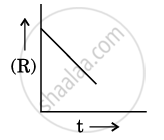
(i) Predict the order of the reaction.
(ii) What is the slope of the curve?
(iii) Write the unit of rate constant for this reaction.
The following data were obtained during the first order thermal decomposition of SO2Cl2 at a constant volume :
SO2Cl2 (g) → SO2 (g) + Cl2 (g)
| Experiment | Time/s–1 | Total pressure/atm |
| 1 | 0 | 0.4 |
| 2 | 100 | 0.7 |
Calculate the rate constant.
(Given : log 4 = 0.6021, log 2 = 0.3010)
The decomposition of N2O5(g) at 320K according to the following equation follows first order reaction:
`N_2O_(5(g))->2NO_(2(g))+1/2O_(2(g))`
The initial concentration of N2O5(g) is 1.24 x 10⁻² mol. L-1 and after 60 minutes 0.20x10⁻² molL-1. Calculate the rate constant of the reaction at 320K.
What is the order of a reaction which has a rate expression; Rate = `"k"["A"]^(3/2)["B"]^1`?
Molecularity of a reaction _____________.
For a complex reaction:
(i) order of overall reaction is same as molecularity of the slowest step.
(ii) order of overall reaction is less than the molecularity of the slowest step.
(iii) order of overall reaction is greater than molecularity of the slowest step.
(iv) molecularity of the slowest step is never zero or non interger.
Match the graph given in Column I with the order of reaction given in Column II. More than one item in Column I may link to the same item of Column II.
| Column I | Column II | |
| (i) | 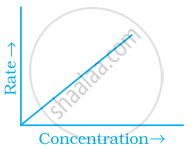 |
|
| (ii) | 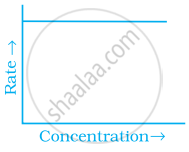 |
(a) 1st order |
| (iii) | 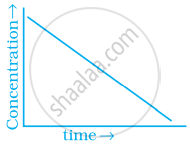 |
(b) Zero-order |
| (iv) |  |
Assertion: The enthalpy of reaction remains constant in the presence of a catalyst.
Reason: A catalyst participating in the reaction, forms different activated complex and lowers down the activation energy but the difference in energy of reactant and product remains the same.
Assertion: Rate constants determined from Arrhenius equation are fairly accurate for simple as well as complex molecules.
Reason: Reactant molecules undergo chemical change irrespective of their orientation during collision.
The number of molecules of the reactants taking part in a single step of the reaction is indicative of ______.
For the reaction, \[\ce{A +2B → AB2}\], the order w.r.t. reactant A is 2 and w.r.t. reactant B. What will be change in rate of reaction if the concentration of A is doubled and B is halved?
The conversion of molecules A to B follow second order kinetics. If concentration of A is increased to three times, how will it affect the rate of formation of B?
Read the following passage and answer the questions that follow:
|
The rate of reaction is concerned with decrease in the concentration of reactants or increase in the concentration of products per unit of time. It can be expressed as instantaneous rate at a particular instant of time and average rate over a large interval of time. A number of factors such as temperature, concentration of reactants, catalyst affect the rate of reaction. Mathematical representation of rate of a reaction is given by rate law: Rate = k[A]x [B]y x and y indicate how sensitive the rate is to change in concentration of A and B. Sum of x + y gives the overall order of a reaction. |
- What is the effect of temperature on the rate constant of a reason? [1]
- For a reaction \[\ce{A + B → Product}\], the rate law is given by, Rate = k[A]2 [B]1/2. What is the order of the reaction? [1]
- How order and molecularity are different for complex reactions? [1]
- A first-order reaction has a rate constant 2 × 10⁻³ s–1. How long will 6 g of this reactant take to reduce to 2 g? [2]
OR
The half-life for radioactive decay of 14C is 6930 years. An archaeological artifact containing wood had only 75% of the 14C found in a living tree. Find the age of the sample.
[log 4 = 0.6021, log 3 = 0.4771, log 2 = 0.3010, log 10 = 1] [2]
The following data was obtained for chemical reaction given below at 975 K.
\[\ce{2NO(g) + 2H2(g) -> N2(g) + 2H2O(g)}\]
| [NO] | [H2] | Rate | |
| Mol L-1 | Mol L-1 | Mol L-1 s-1 | |
| (1) | 8 × 10⁻⁵ | 8 × 10⁻⁵ | 7 × 10⁻⁹ |
| (2) | 24 × 10-5 | 8 × 10⁻⁵ | 2.1 × 10⁻⁸ |
| (3) | 24 × 10-5 | 32 × 10-5 | 8.4 × 10⁻⁸ |
The order of the reaction with respect to NO is ______. (Integer answer)
Assertion (A): Order of reaction is applicable to elementary as well as complex reactions.
Reason (R): For a complex reaction, molecularity has no meaning.
