Advertisements
Advertisements
प्रश्न
Assertion: Rate constants determined from Arrhenius equation are fairly accurate for simple as well as complex molecules.
Reason: Reactant molecules undergo chemical change irrespective of their orientation during collision.
विकल्प
Both assertion and reason are correct and the reason is correct explanation of assertion.
Both assertion and reason are correct but reason does not explain assertion.
Assertion is correct but reason is incorrect.
Both assertion and reason are incorrect.
Assertion is incorrect but reason is correct.
Advertisements
उत्तर
Assertion is correct but reason is incorrect.
Explanation:
To Arrhenius equation `(k =Ae^((-Ea)/(RT)))`; it is found almost accurate for single as well as complex reaction.
However, orientation is essential for the reactant molecules participating in the reaction.
APPEARS IN
संबंधित प्रश्न
A → B is a first order reaction with rate 6.6 × 10⁻⁵m-s-1. When [A] is 0.6m, rate constant of the reaction is
- 1.1 × 10⁻⁵s-1
- 1.1 × 10⁻⁴s-1
- 9 × 10⁻⁵s-1
- 9 × 10⁻⁴s-1
Write molecularity of the following reaction:
2NO(g)+O2(g)→2NO2(g)
For a reaction A + B ⟶ P, the rate is given by
Rate = k [A] [B]2
What is the overall order of reaction if A is present in large excess?
From the rate expression for the following reaction, determine the order of reaction and the dimension of the rate constant.
\[\ce{H2O2_{( aq)} + 3I^-_{( aq)} + 2H^+ -> 2H2O_{(l)} + I^-_3}\] Rate = k[H2O2][I−]
From the rate expression for the following reaction, determine the order of reaction and the dimension of the rate constant.
\[\ce{C2H5Cl_{(g)} -> C2H4_{(g)} + HCl_{(g)}}\] Rate = k[C2H5Cl]
Rate of reaction for the combustion of propane is equal to:
\[\ce{C3H8_{(g)} + 5O2_{(g)} -> 3CO2_{(g)} + 4H2O_{(g)}}\]
Which of the following statement is true for order of a reaction?
For a complex reaction:
(i) order of overall reaction is same as molecularity of the slowest step.
(ii) order of overall reaction is less than the molecularity of the slowest step.
(iii) order of overall reaction is greater than molecularity of the slowest step.
(iv) molecularity of the slowest step is never zero or non interger.
For a general reaction A → B, plot of concentration of A vs time is given in figure. Answer the following question on the basis of this graph.
(i) What is the order of the reaction?
(ii) What is the slope of the curve?
(iii) What are the units of rate constant?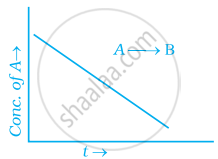
Why is the probability of reaction with molecularity higher than three very rare?
The role of a catalyst is to change
For a reaction \[\ce{Cl2l(g) + 2No(g) -> 2NaCl(g)}\] the rate law is expressed as rate= K[Cl2] [No]2 what is the order of the reaction?
For a first order A → B, the reaction rate at reactant concentration of 0.01 m is found to be 2.0 × 10⁻⁵. The half-life period of reaction.
For a reaction 1/2 A ⇒ 2B, rate of disappearance of A is related 't o the appearance of B by the expression:
At concentration of 0.1 and 0.2 mol L–1 the rates of deem position of a compound were found to be 0.18 and 0.72 mol L–1 m–1. What is the order of the reaction?
The conversion of molecules A to B follow second order kinetics. If concentration of A is increased to three times, how will it affect the rate of formation of B?
A flask contains a mixture of compounds A and B. Both compounds decompose by first-order kinetics. The half-lives for A and B are 300 s and 180 s, respectively. If the concentrations of A and B are equal initially, the time required for the concentration of A to be four times that of B (in s) is ______. (Use ln 2 = 0.693)
A reaction is second order with respect to a reactant. How is the rate of reaction affected if the concentration of the reactant is reduced to half?
