Advertisements
Advertisements
प्रश्न
Match the graph given in Column I with the order of reaction given in Column II. More than one item in Column I may link to the same item of Column II.
| Column I | Column II | |
| (i) | 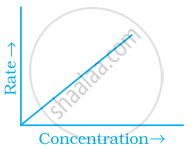 |
|
| (ii) | 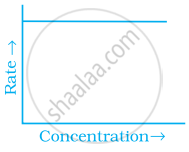 |
(a) 1st order |
| (iii) | 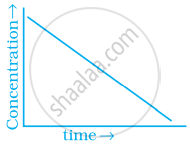 |
(b) Zero-order |
| (iv) | 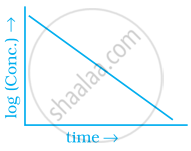 |
Advertisements
उत्तर
| Column I | Column II | |
| (i) | |
(a) 1st order |
| (ii) | |
(b) Zero-order |
| (iii) | |
(b) Zero order |
| (iv) | |
(a) 1st order |
Explanation:
For zero order reaction rate equation may be written as [R] = – kt + [R0]
Which denotes a straight line equation similar to y = mx + c
On transmitting (i) `([R] - [R_0])/t = - k`
`k = ([R_0] - [R])/t`
k = Rate
Rate = `k.[t]^0`
Rate `oo [t]^0`
For a first order reaction `(dx)/(dt) oo` [concentration]
∴ Graph between rate and concentration may be drawn as
`k = 2.303/t log ([R]_0)/([R])`
`(kt)/2.303 = log ([R]_0)/([R])`
`(kt)/2.303 = log[R_0] - log[R]`
\[\ce{log[R] = \underset{(Slope)}{\frac{-k}{2.303}} t + \underset{(Intercept)}{log[R]_0}}\]
APPEARS IN
संबंधित प्रश्न
Write molecularity of the following reaction:
2NO(g)+O2(g)→2NO2(g)
For the reaction:
\[\ce{2A + B -> A2B}\]
the rate = k[A][B]2 with k = 2.0 × 10⁻⁶ mol−2 L2 s−1. Calculate the initial rate of the reaction when [A] = 0.1 mol L−1, [B] = 0.2 mol L−1. Calculate the rate of reaction after [A] is reduced to 0.06 mol L−1.
Mention the factors that affect the rate of a chemical reaction.
A reaction is second order with respect to a reactant. How is the rate of reaction affected if the concentration of the reactant is doubled?
Write resonating structures of ozone.
Define the following term:
Pseudo first-order reaction
Consider a first order gas phase decomposition reaction given below :
\[\ce{A(g) -> B(g) + C(g)}\]
The initial pressure of the system before decomposition of A was pi. After lapse of time ‘t’, total pressure of the system increased by x units and became ‘pt’ The rate constant k for the reaction is given as ______.
Consider the reaction A ⇌ B. The concentration of both the reactants and the products varies exponentially with time. Which of the following figures correctly describes the change in concentration of reactants and products with time?
In a reaction if the concentration of reactant A is tripled, the rate of reaction becomes twenty seven times. What is the order of the reaction?
Why can’t molecularity of any reaction be equal to zero?
Why molecularity is applicable only for elementary reactions and order is applicable for elementary as well as complex reactions?
A catalyst in a reaction changes which of the following?
In the presence of a catalyst, the heat evolved or absorbed during the reaction.
For a reaction R → p the concentration of reactant change from 0.03 m to 0.02 m in minute, calculate the average rate of the reaction using the unit of second.
For a reaction \[\ce{Cl2l(g) + 2No(g) -> 2NaCl(g)}\] the rate law is expressed as rate= K[Cl2] [No]2 what is the order of the reaction?
Which of the following statement is true?
A reaction is second order with respect to a reactant. How is the rate of reaction affected if the concentration of the reactant is reduced to half?
Higher yield of NO in \[\ce{N2(g) + O2 <=> 2NO(g)}\] can be obtained at:
[ΔH of the reaction = +180.7 kJ mol−1]
- higher temperature
- lower temperature
- higher concentration of N2
- higher concentration of O2
Choose the correct answer from the options given below:
