Advertisements
Advertisements
Question
Consider a first order gas phase decomposition reaction given below :
\[\ce{A(g) -> B(g) + C(g)}\]
The initial pressure of the system before decomposition of A was pi. After lapse of time ‘t’, total pressure of the system increased by x units and became ‘pt’ The rate constant k for the reaction is given as ______.
Options
`k = 2.303/t log p_i/(p_i - x)`
`k = 2.303/t log p_i/(2p_i - p_t)`
`k = 2.303/t log p_i/(2p_i + p_t)`
`k = 2.303/t log p_i/(p_i + x)`
Advertisements
Solution
The initial pressure of the system before decomposition of A was pi. After lapse of time ‘t’, total pressure of the system increased by x units and became ‘pt’ The rate constant k for the reaction is given as `k = 2.303/t log p_i/(2p_i - p_t)`.
Explanation:
Consider a first order gas phase decomposition reaction:
\[\ce{A_{(g)} -> B_{(g)} + C_{(g)}}\]
The initial pressure of the system before decomposition of A was Pi.
After lapse of time (t), total pressure of the system increased by x units and became 'Pt'.
In other words, the pressure of A decreased by x atom.
\[\ce{A_{(g)} -> B_{(g)} + C_{(g)}}\]
Initial pressure: Pi atm
Pressure after time t: (Pi – x) atm x atm x atm
Pt = (Pi – x) + x + x = Pi + x atm
x = Pt – Pi
PA = Pressure of A after time t = Pi - x = Pi - (Pi - Pi) = 2Pi - Pt
`k = 2.303/t log (["A"]_0)/(["A"])`
= `k = 2.303/t log p_i/(2p_i - p_t)`
APPEARS IN
RELATED QUESTIONS
For a reaction : 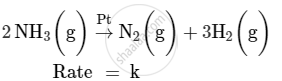
(i) Write the order and molecularity of this reaction.
(ii) Write the unit of k.
For a chemical reaction R → P, the variation in the concentration (R) vs. time (t) plot is given as:
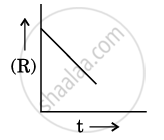
(i) Predict the order of the reaction.
(ii) What is the slope of the curve?
(iii) Write the unit of rate constant for this reaction.
In a reaction between A and B, the initial rate of reaction (r0) was measured for different initial concentrations of A and B as given below:
| A/mol L−1 | 0.20 | 0.20 | 0.40 |
| B/mol L−1 | 0.30 | 0.10 | 0.05 |
| r0/mol L−1 s−1 | 5.07 × 10⁻⁵ | 5.07 × 10⁻⁵ | 1.43 × 10⁻⁴ |
What is the order of the reaction with respect to A and B?
How does calcination differ from roasting?
Write the principle behind the following methods of refining:
Hydraulic washing
The value of rate constant of a pseudo first order reaction ______.
Consider the reaction A ⇌ B. The concentration of both the reactants and the products varies exponentially with time. Which of the following figures correctly describes the change in concentration of reactants and products with time?
For a complex reaction:
(i) order of overall reaction is same as molecularity of the slowest step.
(ii) order of overall reaction is less than the molecularity of the slowest step.
(iii) order of overall reaction is greater than molecularity of the slowest step.
(iv) molecularity of the slowest step is never zero or non interger.
In a reaction if the concentration of reactant A is tripled, the rate of reaction becomes twenty seven times. What is the order of the reaction?
For a general reaction A → B, plot of concentration of A vs time is given in figure. Answer the following question on the basis of this graph.
(i) What is the order of the reaction?
(ii) What is the slope of the curve?
(iii) What are the units of rate constant?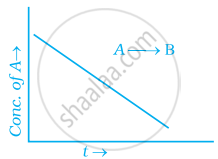
Why is the probability of reaction with molecularity higher than three very rare?
Assertion: Order of the reaction can be zero or fractional.
Reason: We cannot determine order from balanced chemical equation.
Assertion: Rate constants determined from Arrhenius equation are fairly accurate for simple as well as complex molecules.
Reason: Reactant molecules undergo chemical change irrespective of their orientation during collision.
Use Molecular Orbital theory to determine the bond order in each of species, [He2j+ and [He2]2+?
The role of a catalyst is to change
For a first order A → B, the reaction rate at reactant concentration of 0.01 m is found to be 2.0 × 10⁻⁵. The half-life period of reaction.
Identify the order of reaction from the following unit for its rate constant:
L mol–1 s–1
For a chemical reaction starting with some initial concentration of reactant At as a function of time (t) is given by the equation,
`1/("A"_"t"^4) = 2 + 1.5 xx 10^-3` t
The rate of disappearance of [A] is ____ × 10-2 M/sec when [A] = 2 M.
[Given: [At] in M and t in sec.]
[Express your answer in terms of 10-2 M /s]
[Round off your answer if required]
Higher yield of NO in \[\ce{N2(g) + O2 <=> 2NO(g)}\] can be obtained at:
[ΔH of the reaction = +180.7 kJ mol−1]
- higher temperature
- lower temperature
- higher concentration of N2
- higher concentration of O2
Choose the correct answer from the options given below:
