Advertisements
Advertisements
Question
In a reaction if the concentration of reactant A is tripled, the rate of reaction becomes twenty seven times. What is the order of the reaction?
Advertisements
Solution
Rate = `k[A]^alpha` .....(i)
27 × Rate = `k[3A]^alpha` .....(ii)
Dividing equation (ii) by equation (i), we get α = 3
∴ Order of reaction = 3
APPEARS IN
RELATED QUESTIONS
Define “zero order reaction”.
For a reaction: 
Rate = k
(i) Write the order and molecularity of this reaction.
(ii) Write the unit of k.
For a reaction : 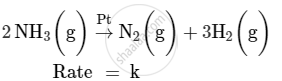
(i) Write the order and molecularity of this reaction.
(ii) Write the unit of k.
For the reaction:
\[\ce{2A + B -> A2B}\]
the rate = k[A][B]2 with k = 2.0 × 10⁻⁶ mol−2 L2 s−1. Calculate the initial rate of the reaction when [A] = 0.1 mol L−1, [B] = 0.2 mol L−1. Calculate the rate of reaction after [A] is reduced to 0.06 mol L−1.
Rate of reaction for the combustion of propane is equal to:
\[\ce{C3H8_{(g)} + 5O2_{(g)} -> 3CO2_{(g)} + 4H2O_{(g)}}\]
Which of the following statement is true for order of a reaction?
Which of the following statements is not correct about order of a reaction.
In any unimolecular reaction:
(i) only one reacting species is involved in the rate determining step.
(ii) the order and the molecularity of slowest step are equal to one.
(iii) the molecularity of the reaction is one and order is zero.
(iv) both molecularity and order of the reaction are one.
Why can’t molecularity of any reaction be equal to zero?
The role of a catalyst is to change
For a reaction A + B → products, the rate law is given by: r = `K[A]^(1/2)`. What is the order of reaction?
For a reaction \[\ce{Cl2l(g) + 2No(g) -> 2NaCl(g)}\] the rate law is expressed as rate= K[Cl2] [No]2 what is the order of the reaction?
The rate constant for the reaction \[\ce{2H2O5 -> 4NO2 + O2}\] is 30 × 10–5 sec–1. if the rate is 204 × 10–5 mol L–1 S–1, then the concentration of N2O5 (in mol–1) is-
If the 0.05 molar solution of m+ is replaced by a 0.0025 molar m+ solution, then the magnitude of the cell potential would be
For a reaction 1/2 A ⇒ 2B, rate of disappearance of A is related 't o the appearance of B by the expression:
The half-life period of a. substance in a certain enzyme catalysed reaction is 138 s. The time required for the concentration of the substance to fall from 1.28 mol–1 to 0.04 mg L–1 is
At concentration of 0.1 and 0.2 mol L–1 the rates of deem position of a compound were found to be 0.18 and 0.72 mol L–1 m–1. What is the order of the reaction?
The number of molecules of the reactants taking part in a single step of the reaction is indicative of ______.
A drop of solution (volume 0.05 ml) contains 3.0 × 10⁻⁶ mole of H+. If the rate constant of disappearance of H+ is 1.0 × 10⁷ mole l-1s-1. It would take for H+ in drop to disappear in ______ × 10-9s.
Which of the following statement is true?
