Advertisements
Advertisements
Question
The following data were obtained during the first order thermal decomposition of SO2Cl2 at a constant volume :
SO2Cl2 (g) → SO2 (g) + Cl2 (g)
| Experiment | Time/s–1 | Total pressure/atm |
| 1 | 0 | 0.4 |
| 2 | 100 | 0.7 |
Calculate the rate constant.
(Given : log 4 = 0.6021, log 2 = 0.3010)
Advertisements
Solution 1
The given reaction is as follows:
SO2Cl2 (g) → SO2(g)+Cl2(g)
Also given:
| Experiment | Time/s–1 | Total pressure/atm |
| 1 | 0 | 0.4 |
| 2 | 100 | 0.7 |
The rate constant k can be calculated as follows:
`k=2.303/tlog `
when t= 100s, k = `2.303/(100s)log`
`k = 2.303/(100s)log`
`k=2.303/(100s) log 4`
`k = 2.303/(100s)xx0.6021`
k = 1.39 x 10⁻²s-1
Therefore, the rate constant is 1.39 x 10⁻²s-1
Solution 2
The thermal decomposition of SO2Cl2 at a constant volume is represented by the following equation:
SO2Cl2→SO2(g) + Cl2(g)
At t =0 P0 0 0
At t=t P0 −p p p
After time t, total pressure is given as:
Pt =(P0−p) + p + p
Pt = P0 + p
This, on rearrangement, gives:
p = Pt − P0
∴ P0−p=P0−(Pt−P0)= 2P0 − Pt
For the first-order reaction, we have:
`k=2.303/tlog P_0/(P_0 - p)`
`=2.303/tlog P_0/(P_0 - p)`
t = 100 s
`k = 2.303/100log 0.42/(0.4 - 0.7) = 1.386 xx 10^(-2)s-1`
APPEARS IN
RELATED QUESTIONS
For the first order thermal decomposition reaction, the following data were obtained:

Time / sec Totalpressure / atm
0 0.30
300 0.50
Calculate the rate constant
(Given: log 2 = 0.301, log3 = 0.4771, log 4 = 0.6021)
For a reaction, \[\ce{A + B -> Product}\]; the rate law is given by, r = k [A]1/2 [B]2. What is the order of the reaction?
Which of the following statements is not correct about order of a reaction.
Rate law for the reaction \[\ce{A + 2B -> C}\] is found to be Rate = k [A][B]. Concentration of reactant ‘B’ is doubled, keeping the concentration of ‘A’ constant, the value of rate constant will be ______.
For a general reaction A → B, plot of concentration of A vs time is given in figure. Answer the following question on the basis of this graph.
(i) What is the order of the reaction?
(ii) What is the slope of the curve?
(iii) What are the units of rate constant?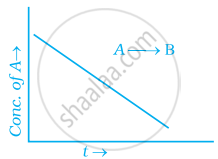
Why can’t molecularity of any reaction be equal to zero?
If the 0.05 molar solution of m+ is replaced by a 0.0025 molar m+ solution, then the magnitude of the cell potential would be
Identify the order of reaction from the following unit for its rate constant:
L mol–1 s–1
A flask contains a mixture of compounds A and B. Both compounds decompose by first-order kinetics. The half-lives for A and B are 300 s and 180 s, respectively. If the concentrations of A and B are equal initially, the time required for the concentration of A to be four times that of B (in s) is ______. (Use ln 2 = 0.693)
A reaction is second order with respect to a reactant. How is the rate of reaction affected if the concentration of the reactant is reduced to half?
